Skip to content
  • Skip to main content
  • Skip to footer

FFLGuard

#1 Firearms Compliance Program in the Country

  • How It Works
    • Are You HOT or COLD?
    • The ABC’s of FFLGuard
    • Law Plus Guidelines (LPGs)
    • Find Your FFLGuard Plan
  • What We Offer
    • On Demand Advice
    • New ATF Inspection Outcomes
    • ATF Lawyers
    • Program Services
    • Program Plans
      • Lite Plan
      • Standard Plan
      • Professional Plan
      • Elite Plan
      • Premium Plan
      • Premium PLUS Plan
      • Corporate Plan
      • Manufacturer
      • Wholesaler / Distributor
      • Executive
    • Add-On Yearly Service Plans
      • Operational Security (OpSec)
      • National Firearms Act (NFA)
      • California Yearly Service Plan (CA-YSP)
        • California Magazine Ban 2025: What FFLs Need to Know
      • Destructive Devices & Explosives Yearly Service Plan
      • Import/Export (I/E-YSP)
    • Additional Services
      • FreshStart
      • JumpStart
      • QuickAudit
      • RecordSentinal
      • SiteVisit
      • DeepDIVe
      • Onsite & Online Training
      • Custom Solutions & Services
    • Travel Fees, Costs, & Expenses
    • Firearms Diagnostics Institute
  • Who We Are
    • Program Personnel
      • Lauren Chiafullo, CEO
      • Bryan Chiafullo
      • Alexis Tunell
      • Avis Lindler
    • National Coordinating Counsel
    • Subject Matter Experts (SMEs)
      • Michael Fronczak
      • Michael Bouchard
      • Kim Pritula
      • Hank Yacek
    • Attorney Advisory Group
  • FAQs, Testimonials, & Resources
    • State-by-State FFL Guides
      • How to Obtain an FFL in Florida
      • How to Get an FFL in Ohio
      • How to Get an FFL in Michigan: A Complete Guide for New Applicants
      • How to Get an FFL in California
      • How to Get a Federal Firearms License (FFL) in Texas
      • How to Get Your FFL in Utah
      • How to Get Your FFL in Illinois
      • How to Get Your FFL in Georgia
      • How to Get Your FFL in Pennsylvania
      • How to Get Your FFL in Maryland
      • How to Get Your FFL in Massachusetts
    • Testimonials
    • FFLGuard – FFL’s FAQs
    • FFLGuard Terms & Conditions
    • Blog and FFL Resources
      • Class 2 SOT Guide for FFL Manufacturers
      • What All FFLs Should Know About ATF Compliance
      • Class 3 Firearms License: Complete Guide to Class 3 SOT for FFLs
      • An FFL’s Complete Guide to the SOT License
      • ATF Form 4473 Compliance Support
      • Firearms Eligibility Check Legal Guidance for FFLs
      • ATF Questions and Answers
      • FFL Types
        • Type 07 FFL Requirements
        • Type 03 FFL Requirements
      • FFL Zoning Requirements: What Every Applicant Needs to Know
  • Login
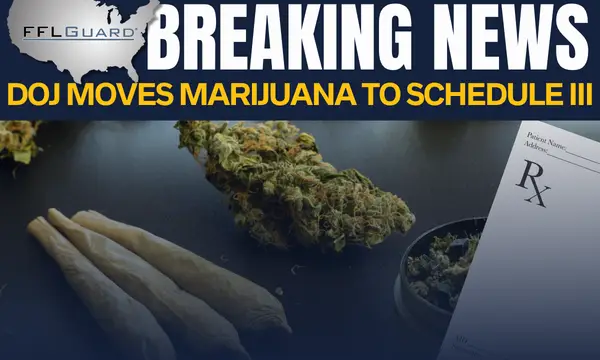
Breaking News: Marijuana Reclassed to Schedule III Controlled Substance

Breaking News: Marijuana Reclassed to Schedule III Controlled Substance

posted on April 26, 2026

April 23, 2024

DOJ Moves Marijuana to Schedule III

Firearm Transfer Rules Have NOT Caught Up

Big news out of Washington today — and yes, your phones may start ringing. 

 
The Department of Justice has moved FDA-approved marijuana products and state-licensed medical marijuana products into Schedule III of the Controlled Substances Act, while also beginning a broader process to evaluate marijuana rescheduling more generally. 
 
The change is significant, and it may have major implications for medical marijuana research, cannabis business operations, taxation, and federal/state marijuana policy.

But Here is the Part FFLs Need to Hear Clearly

This does not mean medical marijuana cardholders are automatically lawful firearm purchasers. Do not treat this announcement as a green light to transfer firearms to known medical marijuana users.
 
Federal firearms law still prohibits firearm possession or receipt by a person who is an unlawful user of, or addicted to, any controlled substance. ATF’s current Form 4473 still asks whether the transferee/buyer is an unlawful user of, or addicted to, marijuana or any depressant, stimulant, narcotic drug, or other controlled substance. The current form also still warns that marijuana use or possession remains unlawful under federal law regardless of whether it has been legalized or decriminalized for medicinal or recreational purposes in the buyer’s state.

Translation

State medical card or not, FFLs are still operating under federal firearms law, Form 4473, and ATF inspection standards.

This is especially important in states that issue medical marijuana cards. A state may authorize medical marijuana use, but that does not automatically remove the federal firearms risk for a current user. Until ATF, DOJ, or Congress provides clear firearms-specific guidance changing how FFLs should handle these transactions, the conservative compliance position remains the same:

If the buyer answers “yes” to the marijuana / controlled substance question on Form 4473, the transfer stops.

If the FFL knows or has reasonable cause to believe the person is a current marijuana user, the FFL should not ignore that information simply because the buyer presents a state-issued medical marijuana card or answers “no.”

ATF’s January 2026 rulemaking on the “unlawful user” definition also continues to focus on whether the person regularly uses a controlled substance over an extended period of time continuing into the present, without a lawful prescription or in a manner substantially different from a prescription. That may become a battleground issue if certain state-licensed medical marijuana products are now treated as Schedule III, but it is not yet an operational clearance memo for FFLs.

So, no victory laps at the gun counter. No freestyle legal interpretations. No “but the news said it’s Schedule III now” transfers.

FFLGuard's Immediate Guidance

Continue following the current Form 4473, current ATF guidance, and existing federal firearms prohibitions unless and until formal firearms-specific guidance says otherwise. This is a developing issue, and 

FFLGuard will continue monitoring DOJ, DEA, ATF, and Form 4473 guidance as this moves forward.

Helpful Resources

  • AP News report on the DOJ announcement
  • CBS News summary of the DOJ order and Schedule III scope
  • Reuters coverage of the policy shift and broader rescheduling process
  • Current ATF Form 4473 marijuana warning
  • Federal Register rule on “unlawful user” definition

As always, when in doubt: pause the transfer, document the issue, and contact FFLGuard before turning a regulatory gray area into an inspection problem.

This is exactly why headlines are not compliance programs. A DOJ announcement about marijuana scheduling does not automatically rewrite federal firearms law, Form 4473, or ATF’s inspection expectations at your gun counter. 

 
Verification beats assumptions — every time. 
 
If a customer has a state medical marijuana card or tells your staff they are a current marijuana user, do not rely on internet commentary, social media lawyers, or “well, I heard it’s Schedule III now” counter logic. Federal firearm transfer rules still matter, and getting this wrong can put the license — not the headline — in ATF’s crosshairs. 
 
FFLs need clear internal procedures for handling marijuana-related transfer questions, staff training, documentation standards, and escalation rules before someone at the counter guesses wrong. 
 
Not an FFLGuard client yet? This is the kind of issue where having firearms-focused compliance and legal support already in place matters.
 

Contact FFLGuard before the next “breaking news” moment becomes your next inspection problem.

Filed Under: Guides, News Tagged With: ATF, controlled substance, guide, marijuana

Footer CTA

Contact

  • Email
  • Phone

Social

  • LinkedIn
  • YouTube
  • Contact Us
  • Login
  • Policies

Copyright © 2026 · FFLGuard · All Rights Reserved.