September 8, 2026
ATF Expands Permissible Repairs and Caliber Changes for Registered Silencers
Jurisdiction: Federal — Bureau of Alcohol, Tobacco, Firearms and Explosives
Action: ATF issued new guidance governing repairs and caliber changes to silencers registered in the National Firearms Registration and Transfer Record
Date: August 28, 2026
Current Status: NEW / AGENCY GUIDANCE CHANGE — NO SEPARATE EFFECTIVE DATE STATED
ATF just moved the line on what may be done to a registered silencer without “making” a new NFA firearm—but it did not erase the line.
In a newly issued Open Letter to All Federal Firearms Licensees on Silencers, ATF states that a complete silencer registered in the National Firearms Registration and Transfer Record may be repaired or converted to a different caliber without being treated as a newly made NFA firearm, provided the work does not:
- Destroy the serialized silencer frame or receiver;
- Remove, obliterate, or alter any required marking; or
- Otherwise result in the making of a new firearm.
What Changed
ATF’s prior guidance treated certain caliber changes—including drilling baffles or end caps—as the making of new silencer parts, each independently regulated as a firearm. The new letter takes a different position for registered, complete silencers.
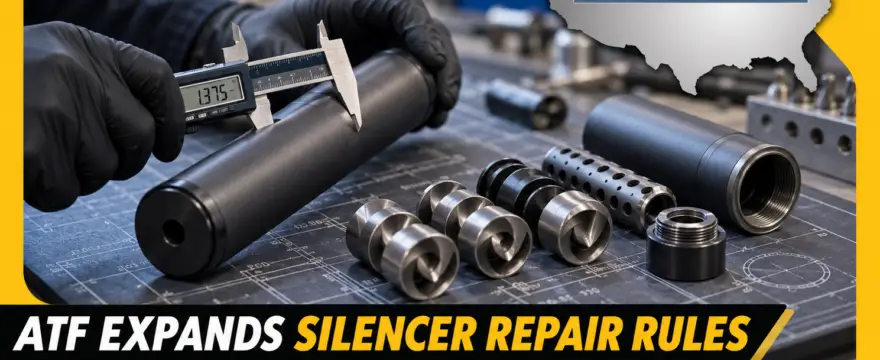
ATF now states that modifying existing components—such as drilling the baffles and end cap of a registered .22-caliber silencer to accommodate a 9mm projectile—does not create new silencer parts because those components remain part of the already registered complete silencer.
The letter also confirms that:
- Qualified manufacturers may obtain silencer parts from other qualified manufacturers and use unregistered and unmarked components to repair or change the caliber of a registered complete silencer.
- Once a replacement component is installed, it becomes part of the complete, marked, and registered silencer, which may then be returned to its registered owner.
- A minimal reduction in the length of the silencer’s outer tube resulting from rethreading may be permissible.
- ATF recommends updating the NFRTR registration information when the caliber of a registered silencer is changed.
What Did Not Change
This is not a permission slip for unrestricted silencer rebuilding or loose-parts sales.
Additional or spare silencer parts intended only for use in assembling or fabricating a silencer remain regulated. When possessed by anyone other than a qualified manufacturer, those parts must be properly marked and registered under the NFA. Transferring silencer parts to an unlicensed individual also requires compliance with the NFA’s registration and transfer requirements for each regulated part.
Likewise, altering, replacing, destroying, or materially modifying the serialized silencer frame or receiver may still result in the making of a new NFA firearm and trigger new marking, registration, and tax requirements.
The letter applies only to caliber changes involving registered silencers. Changes to other registered NFA firearms remain permissible only when the modification does not result in making a different weapon.
Critical Scope Limitation
This guidance applies to complete silencers already registered in the NFRTR.
It does not expand the scope of any suppressor-related injunction, authorize repairs or caliber conversions involving silencers transferred without NFA registration, or resolve the legal status of suppressors acquired through a no-Form-4 transaction. Those issues must continue to be evaluated separately.
What FFLs Should Do Now
FFLs performing or accepting silencer repair and conversion work should immediately review their procedures and:
- Confirm that the silencer is registered in the NFRTR and document the registered owner, manufacturer, model, caliber, and serial number.
- Identify which component constitutes the serialized frame or receiver before beginning work.
- Prohibit any work that would destroy the serialized frame or receiver or alter required markings without further legal and technical review.
- Ensure that unregistered replacement parts are obtained, possessed, and installed only by an appropriately qualified manufacturer.
- Document the original configuration, work performed, replacement components, and completed configuration.
- Submit or assist the registered owner with written notification to ATF when registry information—particularly caliber—should be updated.
- Never return unused or spare silencer components to an unlicensed customer unless each regulated component has been lawfully marked, registered, and transferred.
The FFLGuard Take
This is a meaningful modernization of ATF’s silencer-repair position and should give qualified manufacturers greater flexibility when repairing or changing the caliber of registered silencers.
But the safe harbor is narrow: the silencer must already be registered, the serialized frame or receiver and required markings must remain intact, and loose silencer parts remain heavily regulated. Before accepting any repair or caliber-conversion project outside an established workflow, FFLGuard clients should contact the HelpDesk for transaction-specific guidance.