
Table of Contents
The Short Answer: A straw purchase occurs when someone acquires a firearm for another person while falsely presenting themselves as the actual buyer. It can be illegal even when the intended recipient could legally own the firearm. A genuine gift purchased with the giver’s own money is different. FFLs can face legal consequences for knowingly facilitating unlawful transactions or willfully violating applicable requirements.
For Federal Firearms Licensees (FFLs), understanding and preventing straw purchases is not just a legal obligation—it’s a critical responsibility that helps safeguard communities and protect their business. Under the Bipartisan Safer Communities Act, violations of 18 U.S.C. § 932 can carry up to 15 years in prison, or up to 25 years if the buyer knew or had reasonable cause to believe the firearm would be used to commit a felony, a federal crime of terrorism, or a drug trafficking crime. A fine may be imposed instead of, or alongside, imprisonment. The general felony fine limit for an individual is $250,000, although a higher fine may apply based on financial gain or loss, under 18 U.S.C. § 3571.
As the first line of defense against illegal firearm transactions, FFLs must remain vigilant in identifying and preventing straw purchases. Understanding what constitutes a straw purchase and exploring its serious implications for firearms dealers helps FFLs protect their businesses while maintaining strict compliance with regulations in the United States.
Understanding Straw Purchases
An illegal straw purchase involves a person acquiring a firearm for someone else while falsely claiming to be the actual buyer. The intended recipient does not have to be prohibited from possessing firearms for the false statement to be unlawful. However, purchasing a firearm with your own money as a genuine gift for an eligible recipient is not a straw purchase. The gift must not involve payment, reimbursement, services, or other compensation from the recipient, and the transfer must comply with applicable laws. See ATF’s guidance on straw purchases and genuine gifts.
Federal law restricts firearm possession, receipt, and transfers for specified categories of people. The restrictions differ by category, and statutory exceptions may apply. See 18 U.S.C. § 922. Originally addressed primarily through the Gun Control Act of 1968, the Brady Handgun Violence Prevention Act of 1993 established the background check system that forms the foundation of today’s purchasing requirements. In 2022, the Bipartisan Safer Communities Act established new criminal offenses specifically targeting straw purchases and reinforced existing federal prohibitions. Violations of 18 U.S.C. § 932 can carry up to 15 years in prison, a fine, or both. Under 18 U.S.C. § 3571, the general felony fine limit for an individual is $250,000, although a higher fine may apply based on financial gain or loss.
Federal law explicitly defines several categories of prohibited persons who cannot legally possess firearms or purchase firearms from an FFL. A prohibited person includes:
- Individuals with a conviction of crimes punishable by imprisonment exceeding one year, even if given a lesser sentence
- Fugitives from justice
- Unlawful users or those addicted to controlled substances, including marijuana
- Persons adjudicated as mentally defective or committed to mental institutions
- People unlawfully present in the United States and certain people admitted under nonimmigrant visas, subject to statutory exceptions.
- Those dishonorably discharged from the armed forces
- Individuals who have renounced U.S. citizenship
- People subject to qualifying domestic violence protective orders that meet federal statutory requirements.
- Those convicted of a misdemeanor crime of domestic violence
- People under indictment for a crime punishable by more than one year cannot receive firearms covered by Section 922(n). Indictment alone does not create the same federal possession prohibition as a qualifying conviction.
Some convictions are excluded from the federal definition, and certain pardons, expungements, or restorations of civil rights can affect eligibility. See 18 U.S.C. § 921(a)(20).
Common illegal straw purchase scenarios often involve family members or friends buying firearms for other persons, romantic partners purchasing for their significant others who, in many cases, cannot legally own firearms, or individuals being paid to make purchases for others. The Bureau of Alcohol, Tobacco, Firearms, and Explosives (ATF) regularly encounters cases where people claim they were “doing a favor” for someone, not realizing they were committing a serious criminal offense that could result in significant prison time and substantial fines.
Making a knowingly false statement about the actual buyer or other legally significant information on ATF Form 4473 can constitute a federal crime.

Legal Consequences and Penalties for FFLs
Knowingly facilitating an unlawful firearm transaction can expose an FFL to criminal prosecution. ATF may also pursue license revocation for willful violations of federal firearms law, subject to notice and an opportunity for a hearing under 18 U.S.C. § 923(e). The consequences depend on the conduct and the applicable offense. The reputational damage to a firearms business can be irreparable, leading to the loss of customer trust, community regard and industry standing.
Federal law enforcement agencies actively investigate suspected straw buying, using surveillance, confidential informants, and transaction records to build cases against violators. State laws may impose additional offenses and penalties. Dealers should review the requirements applicable to their jurisdiction.
Identifying and Preventing Straw Purchases
Identifying and preventing straw purchases is a critical responsibility for FFLs that requires vigilance and proper training. Several key behavioral indicators and documentation concerns can signal potential straw purchasers.
Straw Purchase Red Flags for FFLs
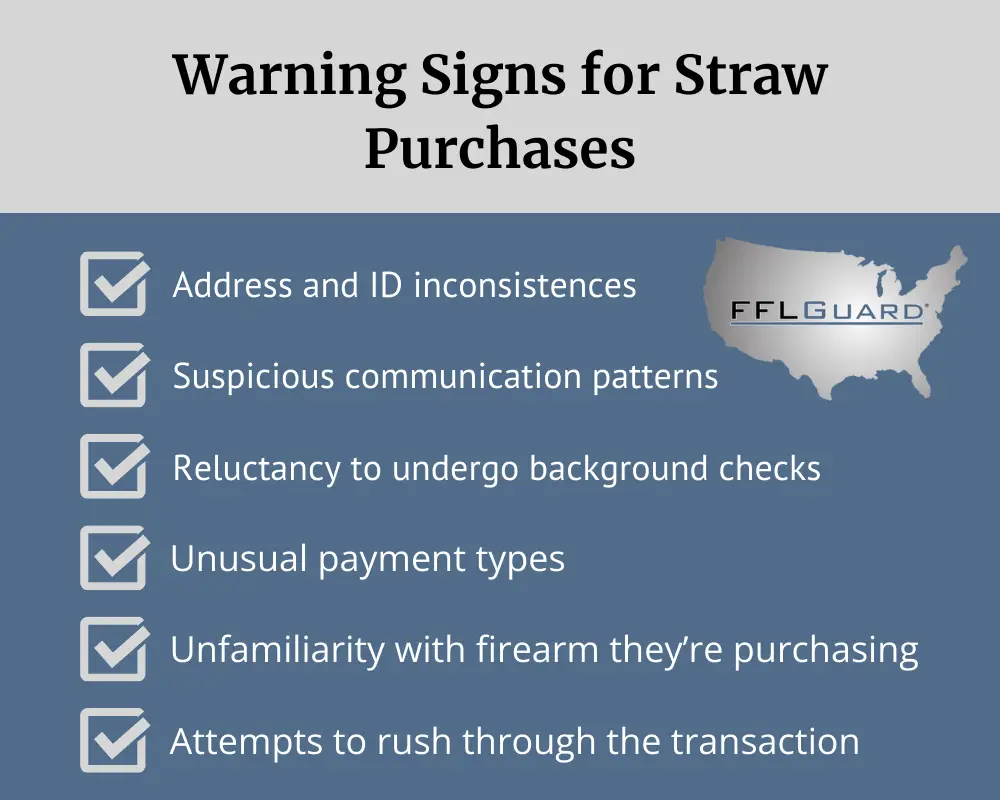
Every licensed firearms dealer should watch for specific red flags that might indicate an alleged straw purchase, including:
- Unfamiliarity with the firearm they’re purchasing
- Limited knowledge about the firearm’s features and operation
- Little interest in physically holding or inspecting the firearm
- Suspicious communication patterns, such as frequent phone calls or text messages during the transaction
- Reluctancy to complete paperwork or undergo background checks
- Attempted avoidance of any cameras or discomfort with recording
- Attempts to rush through the process without asking typical buyer questions
- Payment arrangements suggesting that someone else is funding or directing the purchase. Using a spouse’s credit card as an authorized user does not, by itself, establish a straw purchase.
These behaviors may warrant further questions, but none proves a straw purchase by itself. Evaluate the full circumstances of the transaction.
Documentation and Transaction Warning Signs
When processing firearm purchases, pay close attention to payment methods and purchasing patterns. Some signs to note include:
- Multiple money orders or unusual combinations of payment types
- Buyers selecting firearms that don’t align with their stated intended use
- Purchasing multiple similar firearms without clear justification
- Inconsistencies with addresses
- Identification documents that appear new, altered, or inconsistent with the buyer’s appearance
- Reluctance to provide additional verification when requested
Best Practices to Prevent Straw Purchases
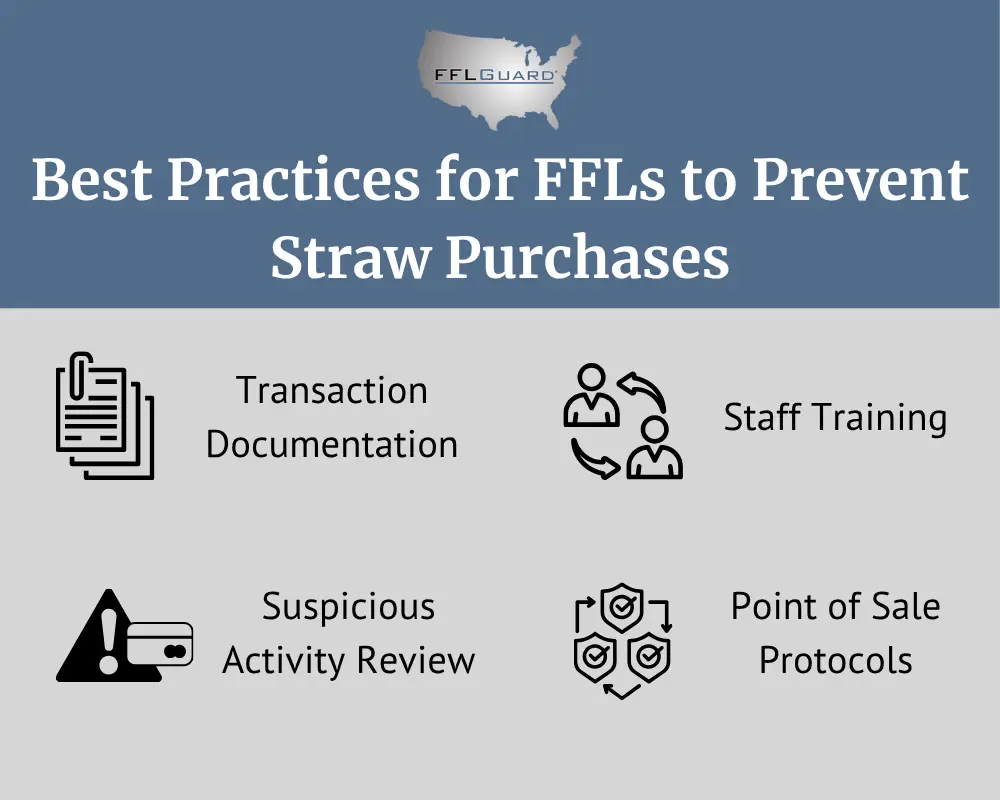
There are several business-wide practices that FFLs can take to stay on top of straw purchases:
- Training: Implement comprehensive staff training programs that cover straw purchase identification and proper response protocols.
- Transaction Documentation: Establish clear procedures that go beyond minimum requirements, which might include transaction notes or customer interaction records.
- Point of Sale Protocols: At the point of sale, consistently follow established systems for every transaction, regardless of circumstances or pressure to complete sales quickly. This can include:
- Thorough completion of ATF Form 4473
- Careful review of identification documents
- Clear communication about legal requirements and penalties for false statements
- Suspicious Activity Review: Consider implementing a policy requiring management review for suspicious transactions or high-risk sales patterns.
- Unwavering Support: Once any employee has stated the transaction should not continue, for any reason, he or she must be supported by all staff; no senior employee or owner should be allowed to overturn the employee’s decision to stop the transaction.
Through diligent application of these practices, FFLs can significantly reduce their risk exposure while maintaining their crucial role in preventing illegal firearm transfers.
Prevent Straw Purchases With FFLGuard
Preventing straw purchases starts with trained staff, careful transaction reviews, and consistent procedures. FFLGuard brings compliance professionals and firearms attorneys together to help dealers prevent problems, respond to ATF concerns, and defend their businesses in covered regulatory matters.
PREVENT. RESPOND. DEFEND.
Our Law Plus Guidelines provide the framework for working with the same compliance and legal team from day one. That’s COMPLIANCE POWERED BY COUNSEL.
Have questions about identifying potential straw purchases or your store’s procedures? Contact FFLGuard to discuss your compliance needs and available support.