
The National Firearms Act (NFA) establishes special regulations for certain firearms and accessories that go beyond the standard requirements for typical firearm purchases. The process for making or transferring an NFA item now depends on the item, the transaction, and current federal, state, and local requirements. ATF’s October 9, 2026 announcement changed enforcement of certain NFA approval and registration requirements, but it did not repeal the NFA. Violations of applicable law can still carry criminal penalties.
Enacted in 1934, the National Firearms Act was originally designed to curb the use of certain firearms frequently used in organized crime during Prohibition. Today, the NFA continues to regulate six specific categories of firearms and accessories that Congress determined warrant additional oversight. Anyone wishing to legally own, manufacture, or transfer these items must navigate the NFA transfer process.
Whether you’re a first-time buyer interested in purchasing a suppressor, a collector looking to acquire a short-barreled rifle, or someone who has inherited an NFA item, understanding the intricacies of the NFA transfer process is essential for legal compliance and avoiding costly mistakes.
What is an NFA Transfer?
An NFA transfer is the regulated process of changing ownership or possession of firearms and accessories classified under the National Firearms Act. The established process uses ATF applications, approval, and registration. ATF’s October 9, 2026 policy makes that federal filing process voluntary for the specified $0-tax items, including suppressors, SBRs, SBSs, and AOWs. That policy does not repeal the NFA or remove other applicable laws.
NFA-Regulated Items
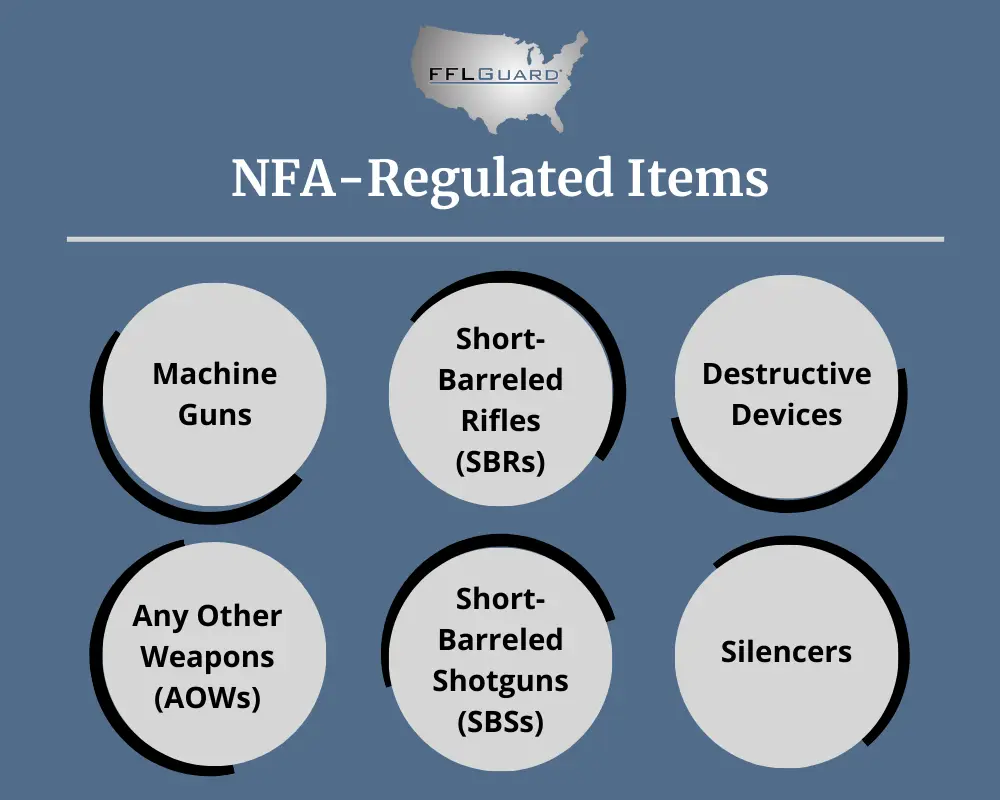
The National Firearms Act regulates six categories of firearms and accessories:
- Short-Barreled Rifles (SBRs): Rifles with a barrel length less than 16 inches or an overall length under 26 inches. These compact weapons combine the controllability of a rifle with increased maneuverability.
- Short-Barreled Shotguns (SBSs): Shotguns with a barrel length less than 18 inches or an overall length under 26 inches. Like SBRs, these offer tactical advantages in close-quarter situations.
- Suppressors (Silencers): Devices designed to reduce the sound and muzzle flash when a firearm is discharged. Despite Hollywood depictions, suppressors don’t completely silence firearms but rather reduce noise to levels less likely to cause hearing damage.
- Machine Guns: Firearms that can fire more than one round with a single pull of the trigger. Due to the 1986 Firearm Owners Protection Act, civilian ownership is limited to machine guns manufactured and registered before May 19, 1986.
- Any Other Weapons (AOWs): A catch-all category including disguised firearms (like pen guns or cane guns), smooth-bore pistols, and certain firearms with forward grips. The federal NFA making and transfer taxes for AOWs are now $0.
- Destructive Devices: This category includes explosives, incendiary devices, and firearms with a bore diameter greater than .50 caliber (with exceptions for shotguns with a sporting purpose).
The ATF meticulously tracks all firearms transfers of these regulated items through a registration system. Each item has a unique serial number and registration that must follow it throughout its existence, creating an unbroken chain of ownership that the ATF can verify..
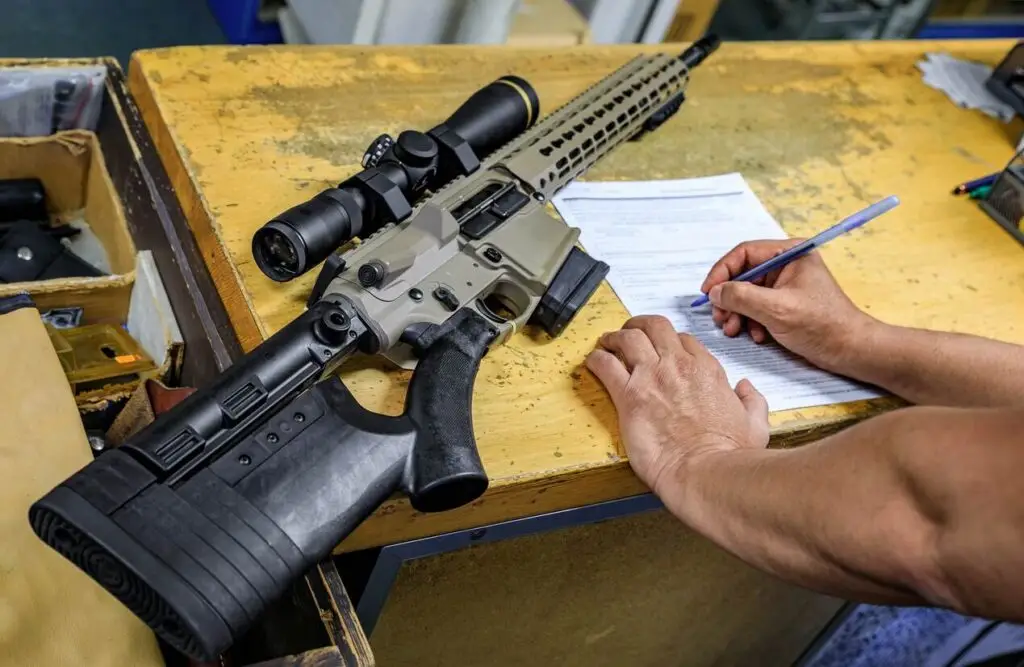
Steps to Complete an NFA Firearm Transfer as an FFL
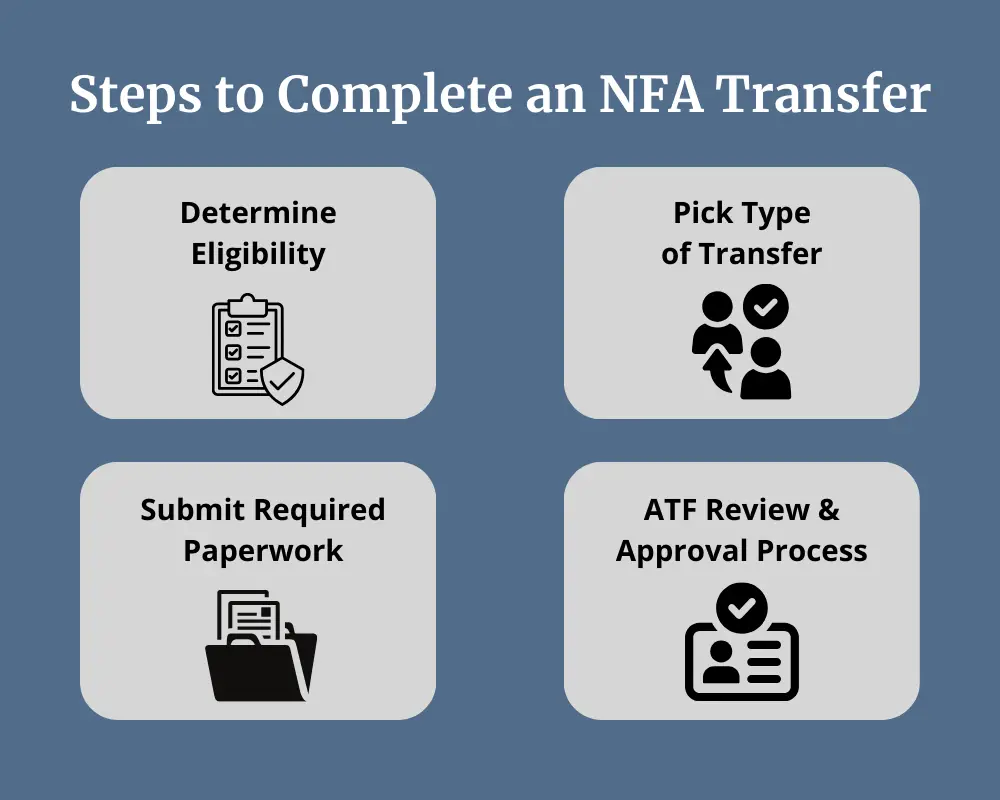
The steps below describe the established NFA application and registration process. ATF continues accepting voluntary NFA filings for suppressors, SBRs, SBSs, and AOWs under its October 9, 2026 enforcement policy. Machine guns and destructive devices remain subject to all NFA requirements. Applicable GCA, state, and local requirements also remain in effect.
Step 1: Determine Eligibility
Before initiating an NFA transfer, you must first ensure you’re legally eligible to possess such items. Generally, anyone who can legally purchase a firearm under federal law can own NFA items, provided they’re legal in their state of residence. To qualify, you must:
- Be at least 21 years old for transfers from dealers (18 for some Form 1 applications)
- Be legally eligible to purchase firearms (not a prohibited person)
- Have no felony convictions
- Have no domestic violence convictions
- Not be a user of illegal drugs
- Never have been adjudicated mentally defective or committed to a mental institution
- Be a resident of a state where the specific NFA item is legal
It’s crucial to verify that the particular NFA item you’re interested in is legal in your state, as state laws can be more restrictive than federal regulations. For example, while suppressors are federally legal with proper registration, they remain prohibited in states like California, New York, and Hawaii.
Step 2: Select the Type of Transfer
The NFA transfer process varies depending on your specific situation. The ATF uses different forms for different types of transfers:
- Form 1 (ATF Form 5320.1): This “Application to Make and Register a Firearm” is used when you intend to manufacture or convert an existing firearm into an NFA item (such as converting a rifle into an SBR by installing a shorter barrel). You must receive approval before modifying.
- Form 3 (ATF Form 5320.3): This form facilitates tax-free transfers between Special Occupational Taxpayers (SOTs), which are Federal Firearms Licensees with a special designation to deal in NFA items. As a consumer, you generally won’t use this form directly, but your FFL dealer might use it to acquire an NFA item before transferring it to you.
- Form 4 (ATF Form 5320.4):
- This “Application for Tax Paid Transfer and Registration of Firearm” is the most common form for individuals. It’s used when purchasing an NFA item from a dealer or another individual. The federal transfer tax is $0 for suppressors, SBRs, SBSs, and AOWs. Taxable transfers of machine guns and destructive devices remain subject to a $200 tax.
- Form 5 (ATF Form 5320.5): This form is used for tax-exempt transfers in special circumstances, such as transfers to government agencies or inheritance of NFA items.
Under current ATF enforcement policy, NFA making, transfer, and registration applications for suppressors, SBRs, SBSs, and AOWs may be submitted voluntarily, while applicable NFA filing and approval requirements remain in effect for machine guns and destructive devices.
FFLGuard identifies continuing the established NFA process, including applicable filings and approvals, as the lowest-risk approach.
Step 3: Submit the Required Paperwork
If you submit an NFA application, you’ll need to gather and submit the supporting documents required for that form.
For Individual Applications:
- Completed ATF form (1, 4, or 5 as appropriate)
- Fingerprints and photographs prepared according to the selected form and filing method
- If purchasing from a dealer, work with the dealer to complete the application.
For Trust or Legal Entity Applications:
- Completed ATF form
- Copy of the trust or entity documents
- Fingerprints for each responsible person, submitted in the required format
- Photographs of all responsible persons
- ATF Form 5320.23, NFA Responsible Person Questionnaire, for each responsible person, as applicable.
- Payment of appropriate tax
The ATF now offers two submission methods:
- Paper Forms: The traditional method involves mailing physical forms to the ATF. While reliable, this typically results in longer wait times
- eForms: The ATF’s electronic filing system allows for digital submission of most NFA forms. This system generally results in faster processing times, particularly for Form 1 applications.
Step 4: ATF Review and Approval Process
After submission, the ATF conducts a thorough review of your application:
- Initial Processing: Your form is logged into the system and given a control number.
- Background Check: The ATF performs extensive background checks on all applicants or responsible persons.
- Technical Review: Examiners verify that all information is correct and that the firearm qualifies for the registration requested
- Final Approval: Once approved, the ATF stamps the form (hence the term “tax stamp”) and returns it to the transferor or applicant.
Wait times vary considerably based on current ATF workload, submission method, and application type. eForms typically take 3-6 months for approval, while paper forms can take 7-12 months or longer.
Form 3 transfers between dealers are usually the fastest, often completed within weeks. You can check the status of paper forms by calling the ATF NFA Division, while eForm submissions can be tracked through the ATF’s online portal. If your application is denied, the ATF will provide a reason, and your tax payment will typically be refunded.
Navigating the NFA transfer process requires attention to detail, patience, and a thorough understanding of both federal and state regulations. While the process may seem daunting, the ability to legally own and enjoy these specialized firearms and accessories makes the effort worthwhile for many enthusiasts.
Staying compliant with ATF regulations is essential not only to avoid legal complications but also to preserve our Second Amendment rights through responsible ownership. The firearms community benefits when all NFA owners adhere to the established legal framework.
For those new to NFA items, seeking guidance from experienced dealers, attorneys specializing in firearms law, or established online communities can provide valuable assistance. Many gun trust attorneys offer reasonable flat fees for creating proper NFA trusts, and quality dealers pride themselves on walking customers through the transfer process step by step. Always verify current requirements directly with the ATF or through legal counsel before initiating an NFA transfer.
What FFLGuard Can Offer FFLs
Prevent. Respond. Defend.
FFLGuard brings firearms compliance and legal counsel together as one team. We help FFLs prevent problems through practical guidance, training and compliance support, respond when ATF raises concerns, and defend their licenses in covered regulatory matters.
Our firearms attorneys, former ATF professionals and compliance team work together using our Law Plus Guidelines. As NFA guidance changes, we help clients understand current requirements, assess their options and follow documented procedures for their transactions. Legal support is provided within the scope of the client’s engagement.
Compliance powered by counsel.
Find your plan today or Contact us to discuss your FFL’s compliance needs and learn how our legal and compliance team can help.
FAQs
Yes, but with restrictions. You must file ATF Form 5320.20 (Application to Transport NFA Firearms) and receive approval before crossing state lines with most NFA items. Suppressors are exempt from this requirement as of 2017.
Yes, but the process varies based on the stage of your application. Before approval, you can request withdrawal in writing. After approval but before taking possession, you can decline to complete the transfer. However, tax stamps are generally non-refundable once the application has been processed.
You should notify the ATF NFA Division in writing of your new address for their records.