
At a Glance: While there have been legislative efforts to remove suppressors from the NFA, they have not been fully deregulated. The making and transfer taxes for suppressors dropped to $0 on January 1, 2026 and NFA registration and prior approval requirements are no longer enforced for suppressors. Suppressors remain listed in the NFA, state and local laws still apply, and the enforcement policy could change.
Firearm suppressors or silencers as they’re referred to in regulations, are regulated under the National Firearms Act (NFA). But will they be removed from the NFA, making them like any other firearm? This question has sparked debate among gun owners, advocates for the Second Amendment, and lawmakers alike.
Suppressors are designed to reduce the noise (or “report”) generated by firearms, primarily for hearing protection. They remain classified as firearms under both the NFA and the Gun Control Act. Under ATF’s current guidance, prior NFA approval and registration requirements are no longer enforced for suppressors. Dealer transfers to unlicensed persons still require Form 4473 and, unless an exemption applies, a NICS background check.
So, what does the future hold for suppressors? Will they continue to be regulated under the NFA, or is deregulation on the horizon? Let’s dive into the legislative efforts and the potential changes to NFA regulation.
What is the National Firearms Act (NFA)?
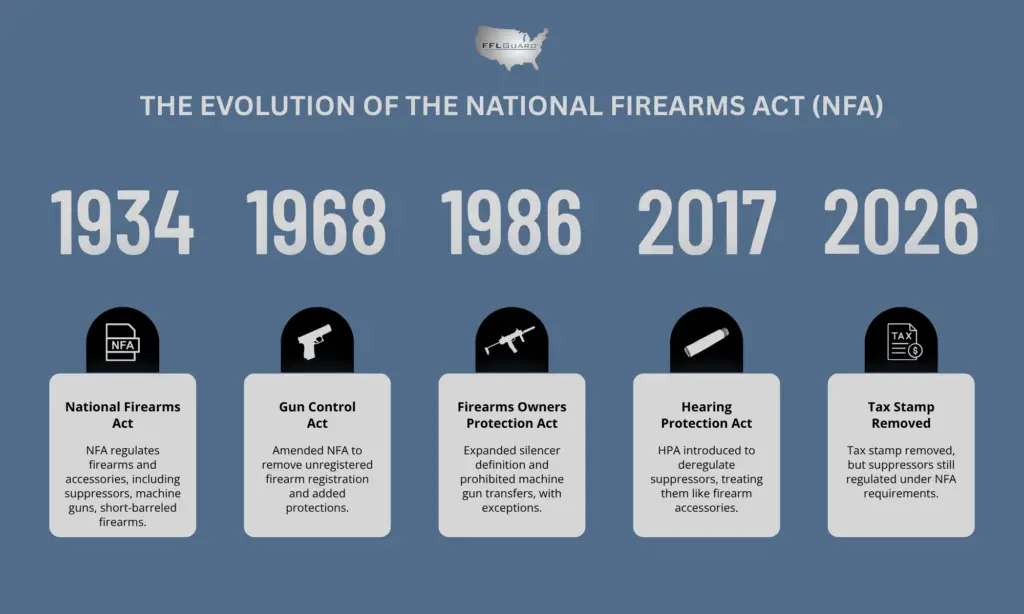
The National Firearms Act (NFA) was passed in 1934 as a way for the federal government to regulate certain firearms and firearm accessories. The purpose was to address concerns about violence and criminal use of firearms considered to be rampant during the Prohibition Era by making it difficult and expensive for civilians to legally possess certain weapons, such as machine guns, short-barreled rifles (SBRs), short-barreled shotguns (SBSs), certain firearms with hidden/concealed appearance (any other weapon), and firearm suppressors.
Regulation of Suppressors
Suppressors fall under the NFA and are classified as firearms. That’s right – a suppressor is a “firearm” in the eyes of the National Firearms Act. Since October 9, 2026, ATF has accepted Form 4 applications voluntarily for suppressor transfers under its nonenforcement policy. Their making and transfer taxes have been $0 since January 1, 2026. Applicable Gun Control Act requirements and state and local laws remain in effect, including any state requirements tied to federal registration.
The NFA’s primary goal was to regulate firearms and firearm accessories that could be easily concealed or were perceived as particularly dangerous. Suppressors were included due to concerns about their potential use in criminal activities. Many argue these concerns were misplaced and resulted from a common misconception that a suppressor fully “silences” the sound of a firearm. In reality, the sound is merely suppressed to a level that, in most cases, would not cause damage to a normal adult’s hearing. This means their primary function is not truly for covert firearm activity, but to protect hearing, one of the few organs medical science has not been able to restore or replace if damaged. This makes suppressors continued regulation a point of contention among many gun rights and hearing protection advocates.
Legislative Efforts to Deregulate Suppressors
One of the most significant legislative efforts to deregulate suppressors was the introduction of the Hearing Protection Act (HPA). This bill aimed to remove suppressors from the NFA entirely, making them as accessible as any other firearm accessory.
The HPA was first introduced in 2017, with the goal of deregulating suppressors by removing them from the NFA. It gained momentum among lawmakers, especially following the support of Second Amendment advocates and groups like the National Rifle Association (NRA), Second Amendment Foundation, and Firearms Policy Coalition.
Key Supporters:
- President Trump voiced his support for the bill, with many Republican lawmakers also backing the HPA, citing the importance of hearing protection for gun owners.
- Support came from gun rights organizations that argued that suppressors should not be heavily regulated when they are primarily used to protect hearing.
Challenges in Legislation
Despite widespread support, the HPA has faced significant challenges in Congress. Political opposition, competing priorities, and a divided Congress have prevented the bill from passing.
Byrd Rule
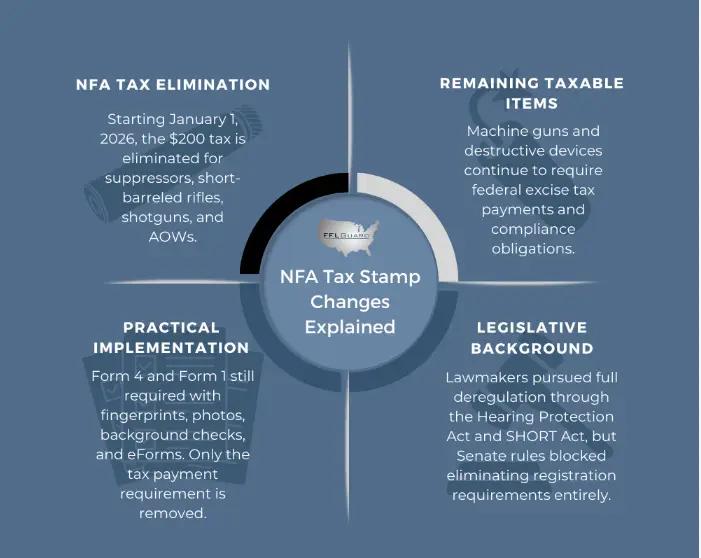
In the legislative reconciliation process, the Senate Parliamentarian applied the Byrd Rule, which prohibits extraneous policy changes in budget reconciliation bills. This decision blocked the full deregulation of suppressors, as it was deemed unrelated to the budget.
Opposition from Gun-Control Groups
Opponents, such as Everytown and Giffords, argue that removing suppressors from the NFA would undermine public safety and make it harder for law enforcement to track firearms. They maintain that suppressors could be misused in criminal activities.
How the NFA Tax Stamp for Suppressors Was Removed
The tax stamp has long been a financial burden for gun owners seeking suppressors. The federal making and transfer taxes for suppressors remained $200 from 1934 until Public Law 119-21 reduced them to $0 effective January 1, 2026. Many have argued that it acts as an unnecessary barrier for law-abiding gun owners seeking suppressors for legitimate uses.
Recent Legislative Change (2026)
The One Big Beautiful Bill Act, Public Law 119-21, was signed into law on July 4, 2025. Section 70436 reduced the making and transfer taxes for suppressors, short-barreled rifles, short-barreled shotguns, and AOWs to $0 effective January 1, 2026. This change did not remove suppressors from the NFA’s regulatory framework.
A separate change followed on October 9, 2026, when ATF announced nationwide nonenforcement of NFA prior approval, registration, and related tax-stamp requirements for these four categories. ATF continues to accept voluntary applications. Dealer background check requirements, applicable special occupational taxes, and state and local laws remain in effect.
Lawsuits Challenging NFA Requirements
According to ATF’s October 9, 2026 open letter, a federal district court in Texas ruled in Silencer Shop Foundation v. ATF on August 5, 2026, with an injunction effective August 12. The court held that the challenged NFA making, transfer, and registration provisions for the four $0-tax categories could no longer be upheld under Congress’s taxing power. The injunction protects the plaintiffs and other persons specified in the court’s order.
ATF subsequently adopted a nationwide nonenforcement policy effective October 9, 2026. That policy extends beyond those protected by the injunction, but it does not repeal the NFA. ATF warns that enforcement could resume if legal circumstances change or the government withdraws the guidance. Federal law does not automatically grandfather unregistered NFA items or generally allow them to be registered later.
Recent developments affecting suppressor regulation include:
Constitutional Challenges (2025–2026): Brown v. ATF, filed August 1, 2025, and Roberts v. ATF, filed February 26, 2026, challenge remaining NFA requirements following the elimination of making and transfer taxes for covered firearms. Both cases remain pending as of October 15, 2026.
Congressional Feedback: On November 10, 2025, Rep. Andrew Clyde and other members of Congress sent a letter to then-Attorney General Pam Bondi urging the DOJ to oppose continued NFA registration requirements for firearms whose making and transfer taxes were eliminated. Their August 2026 follow-up letter documents that earlier request.
Legal Precedent (United States v. Peterson): In its revised 2025 opinion in United States v. Peterson, the Fifth Circuit rejected Peterson’s Second Amendment challenge to the suppressor-registration requirement as applied to his case.
Why Full Removal from the NFA Hasn’t Happened Yet
The full removal of suppressors from the NFA remains a complex issue due to various political and legislative hurdles.
- Byrd Rule: The Byrd Rule played a pivotal role in preventing full deregulation of suppressors. This rule prevents extraneous policy changes in budget bills, preventing the inclusion of suppressor deregulation in recent legislative efforts.
- Senate Opposition: While many lawmakers support deregulation, the Senate has blocked efforts to fully remove suppressors from the NFA. This has primarily been due to the concern that it could create complications in tracking firearms and lead to misuse.
- Political Landscape: The current political climate and the federal government’s stance on firearms regulation have made it difficult to gather sufficient support for the full deregulation of suppressors. The Second Amendment debate plays a significant role in shaping these discussions.
- Timing Issues: Future elections could shift the balance of power in Congress, potentially leading to more favorable conditions for suppressor deregulation. However, the process remains uncertain.
- DOJ Support: Current Enforcement Policy: DOJ and ATF’s October 9, 2026 guidance stops enforcement of NFA prior approval and registration requirements for suppressors and the other three $0-tax categories. Congress has not removed these items from the NFA, and the policy does not override state or local restrictions.
What Would Removing Suppressors from the NFA Mean?
Suppressors have not been removed from the NFA, but ATF’s October 9, 2026 policy already allows dealer transfers without prior NFA approval or registration. Dealer transfers to unlicensed persons still require Form 4473, a NICS background check unless exempt, and acquisition and disposition records. Removing suppressors from the NFA by statute would change the underlying law rather than rely on an enforcement policy that could be withdrawn.
Impact on Gun Owners:
- Under current ATF policy, suppressor buyers may proceed without submitting an NFA transfer application, fingerprints, or photographs for federal registration. State and local requirements still apply.
- Dealer transfers to unlicensed persons still require Form 4473 and, unless an exemption applies, a NICS background check.
- It would create a more straightforward process for law-abiding citizens who wish to own suppressors for hearing protection and other legitimate uses.
Impact on Law Enforcement:
- Law enforcement may face difficulties in tracking suppressed firearms that are legally registered. However, according to NSSF, available data does not support this claim, reporting that from 1995-2005 only in only fifteen (15) federal cases were suppressors actually used in the commission of the alleged crime, while there were about 50,000 suppressors registered (0.03%),
- Concerns about potential misuse, especially if it becomes easier for criminals to acquire suppressors.
Impact on FFLs:
- Simplified Sales Process: Under ATF’s current policy, FFLs may transfer suppressors without an approved Form 4 while continuing to meet applicable Gun Control Act and state and local requirements. ATF also continues to process Form 4 applications submitted voluntarily.
- Increased Sales Potential: With fewer regulatory hurdles and reduced labor investment, FFLs could see an increase in customer interest and suppressor sales, as the process would be similar to buying other firearms.
State vs. Federal Law:
- Even if federal law changes, state laws may still impose restrictions. This would create a complex situation where some states allow suppressor ownership while others regulate or ban them.
FFLGuard: Your Partner in NFA Compliance
A change in federal enforcement policy can raise practical questions about your next sale, your records, and the requirements in your state. FFLGuard helps clients evaluate those questions with compliance professionals and firearms counsel working together from DAY ONE.
PREVENT. RESPOND. DEFEND.
Through its Law Plus Guidelines, FFLGuard helps clients establish consistent practices and document decisions before an ATF issue arises. The same coordinated team supports responses to ATF concerns and defense of covered regulatory matters.
Learn How FFLGuard Works, then explore the LPGs behind the program. To discuss support for your business, find your plan or contact our team.