September 4, 2026
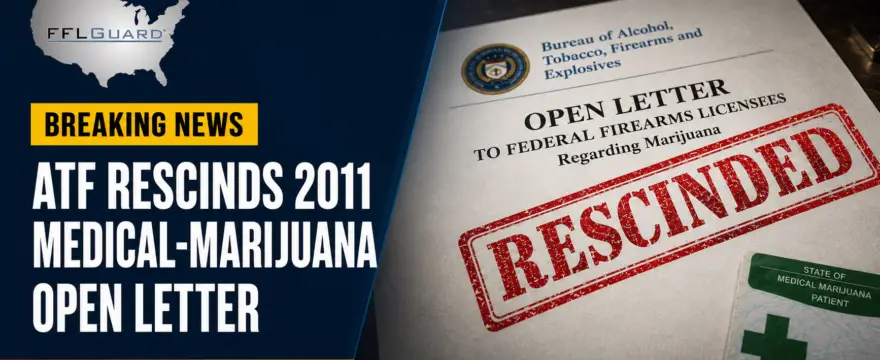
Breaking News: ATF Rescinds 2011 Medical-Marijuana Open Letter
Jurisdiction: Federal
Status: NEW / CONFIRMED GUIDANCE RESCISSION
Effective Date: Not identified by ATF
There is now one very important word stamped across ATF’s 2011 Medical-Marijuana Open Letter:
RESCINDED.
On September 21, 2011, ATF instructed Federal Firearms Licensees that possession of a state-issued medical-marijuana card, by itself, provided “reasonable cause to believe” a prospective transferee was an unlawful user of a controlled substance. Under that guidance, an FFL was instructed to refuse the transfer—even when the buyer answered “No” to the applicable drug-use question on ATF Form 4473.
ATF’s official copy of that letter is now expressly marked “RESCINDED.”
What This Means for FFLs
The prior categorical rule of thumb—medical-marijuana card equals automatic reasonable cause to deny—should no longer be treated as operative ATF guidance.
A medical-marijuana card, standing alone, should not be used as an automatic denial mechanism based on the rescinded letter.
That is the headline. Now for the part where everyone keeps their compliance hat firmly attached.
What Has Not Changed
The rescission does not erase 18 U.S.C. §§ 922(d)(3) or 922(g)(3). Federal law continues to address persons who are unlawful users of or addicted to controlled substances, and an FFL still may not transfer a firearm or ammunition when the FFL knows or has reasonable cause to believe the recipient is legally prohibited.
ATF’s current regulation requires evidence of sufficiently regular and recent unlawful use demonstrating ongoing conduct. It expressly states that isolated, sporadic or discontinued use does not qualify as unlawful current use.
The Supreme Court’s June 18, 2026 decision in United States v. Hemani also held that the government’s prosecution of Hemani under § 922(g)(3)’s unlawful-user provision violated the Second Amendment under the facts presented. The decision was as-applied; it did not delete § 922(g)(3), and the Court expressly declined to decide the separate prohibition involving persons who are “addicted to” a controlled substance.
What FFLs Should Do Now
FFLs should:
Remove any SOP, training material, counter guide or software instruction that treats possession of a medical-marijuana card alone as an automatic basis for denial under the 2011 ATF letter.
Continue completing ATF Form 4473 and conducting the required NICS or state point-of-contact background check.
Distinguish the mere possession of a medical-marijuana card from transaction-specific evidence of actual current unlawful use, addiction, impairment, admissions or other facts that may create reasonable cause to believe the person is prohibited.
Avoid inventing new questions, interrogations or homemade marijuana questionnaires. Compliance is not improved by freelancing at the gun counter.
Contact the FFLGuard HelpDesk before completing a transaction when the available facts create uncertainty regarding the buyer’s eligibility.
The FFLGuard Bottom Line
The letter has been rescinded. The statutes have not.
FFLs should stop using a medical-marijuana card as a categorical shortcut and return to a transaction-specific analysis based on current law, current regulations and the actual facts presented.
FFLGuard identified the rescission on September 4, 2026. ATF has not stated when the rescission became effective and has not identified replacement marijuana-specific dealer guidance. Until ATF provides additional information, this development should be characterized as a confirmed substantive guidance change with an undetermined rescission date.
Official Sources
Stay sharp. Stay current. And when ATF retires a 15-year-old instruction without announcing when it happened, keep the FFLGuard HelpDesk close.
The FFLGuard Team
