A Candid Conversation About FFL Revocations, Regulatory Reform, and the Future of ATF
When the head of ATF sits down with an attorney who’s spent decades challenging the agency on behalf of firearms businesses, you’d expect fireworks. Instead, you might be surprised how much they agree on.
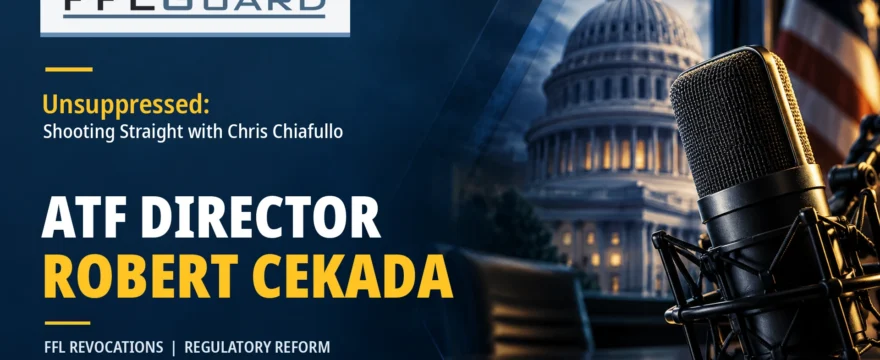
On the latest episode of Unsuppressed: Shooting Straight with Chris Chiafullo, FFLGuard National Coordinating Counsel Chris Chiafullo sits down with Bureau of Alcohol, Tobacco, Firearms and Explosives (ATF) Director Robert “Rob” Cekada for a candid, unscripted conversation about the agency’s changing direction, the real cost of federal firearms license revocations, and what meaningful reform could mean for the firearms industry.
Forget the polished press releases and carefully choreographed Washington talking points.
This conversation gets into the issues federal firearms licensees (FFLs), manufacturers, distributors, importers, and other regulated businesses face every day.
And perhaps most importantly, it raises a question that’s long overdue:
Should an honest compliance mistake cost someone their business?
Zero Tolerance, Maximum Consequences
Few regulatory policies have had a more profound effect on licensed firearms businesses than ATF’s previous zero-tolerance enforcement approach.
During their conversation, Chiafullo reflects on the extraordinary increase in license revocation proceedings that FFLGuard handled under the previous administration.
After nearly two decades of representing firearms businesses, he described how the number of revocation matters his team confronted surged in a comparatively short period.
The resulting financial burden extended beyond attorney fees. Businesses faced legal expenses, operational disruptions, uncertainty, and the possibility of losing licenses they depended upon for their livelihoods.
Cekada acknowledged that some revocation proceedings involved licensees without histories suggesting criminal involvement or persistently poor compliance.
He questioned whether putting otherwise legitimate businesses out of operation over correctable mistakes actually advances public safety.
And the damage didn’t always appear in the government’s final revocation statistics.
Some licensees simply couldn’t afford to fight.
They surrendered licenses, liquidated inventory, and walked away from businesses they’d spent years building.
That’s not just an administrative outcome. That’s a family business, a payroll, and someone’s life’s work.
The conversation makes an important distinction: Intentional wrongdoing and serious or repeated compliance failures demand accountability. But enforcement decisions should also recognize the circumstances of the violation and the licensee’s history.
The Difference Between Bad Actors and Good Businesses
One theme runs throughout the interview: The firearms industry isn’t the enemy of effective law enforcement.
Chiafullo and Cekada discuss the importance of distinguishing businesses that are genuinely attempting to comply from individuals deliberately engaging in criminal conduct.
Cekada describes his experiences meeting firearms manufacturers and industry representatives and recognizing the families, employees, and legitimate business owners behind those operations.
Chiafullo makes a complementary point.
Like any industry, firearms businesses can have bad actors. Identifying those individuals and holding them accountable is appropriate.
But treating every licensee as a potential criminal is neither a practical compliance strategy nor an effective substitute for investigating actual criminal activity.
The goal should be to pursue wrongdoing without making legitimate commerce collateral damage.
That distinction matters for every FFL, whether it operates a single retail location or manages a nationwide manufacturing and distribution business.
Why Regulatory Reform Takes Longer Than a Press Release
The discussion also offers a rare look at why changing ATF regulations isn’t as simple as announcing a new policy.
Cekada describes the administrative rulemaking process, the layers of legal review, and the need to develop a defensible record supporting regulatory changes.
He also discusses significant staffing losses across the agency, including attorneys, special agents, and Industry Operations Investigators.
Those constraints matter.
As ATF works through emerging NFA issues and other priorities, many of the same personnel are needed to support longer-term regulatory reform.
The resulting challenge is familiar to anyone who operates a business: More priorities than available resources.
But there’s an additional consideration.
Regulatory changes need to withstand legal scrutiny, including challenges that may come under future administrations.
Cekada emphasizes the importance of building a record capable of supporting changes over time rather than pursuing quick announcements that may ultimately prove vulnerable.
For FFLs, that’s an important reality check.
A new enforcement philosophy may provide welcome relief, but businesses still need to distinguish between agency policy, formally adopted regulations, federal statutes, and applicable state law.
Enforcement discretion and legal repeal are not interchangeable.
An ATF Director Who Answers the Critics
One of the more unexpected discussions involves Cekada’s willingness to engage directly with the public, including on social media.
Let’s face it: Running ATF isn’t exactly a job where everyone sends you a thank-you card.
The agency faces criticism from opposing directions, and its Director doesn’t get the luxury of satisfying every audience.
Cekada acknowledges ATF’s historical shortcomings in communicating its work and explains why he believes the agency must do a better job of telling its story.
He discusses responding to misinformation, accepting legitimate criticism, and addressing service complaints that otherwise might never reach senior leadership.
When businesses encounter unanswered inquiries or unresolved problems, Cekada says the agency has a responsibility to respond.
That’s not an extravagant customer-service promise.
It’s a reasonable expectation of an agency that regulates thousands of businesses whose operations depend on timely government decisions.
And it reflects a broader issue addressed throughout the interview: Accountability shouldn’t flow in only one direction.
Licensees have obligations to regulators.
Regulators also have responsibilities to the businesses they oversee.
What This Means for Your FFL
While the conversation signals an interest in a different relationship between ATF and the firearms industry, it does not eliminate existing compliance obligations.
FFLs should continue to maintain accurate records, train employees, follow applicable legal requirements, and address deficiencies promptly.
They should also recognize that agency leadership and enforcement priorities can change.
A defensible compliance program must work under the law as it exists—not simply under the enforcement philosophy a particular administration prefers.
For FFLGuard clients, that’s precisely why counsel-backed compliance guidance remains important.
Changing policies create opportunities, but they also create questions involving legal interpretation, operational procedures, inventory, transactions, and potential future exposure.
The right answer is rarely to abandon established compliance systems based on a headline.
A Different Conversation. A Common Objective.
Perhaps the most compelling aspect of this episode isn’t a proposed regulatory reform or a particular enforcement statistic.
It’s the relationship between two professionals whose careers have regularly placed them on opposite sides of the table.
Chiafullo has represented firearms businesses in adversarial matters involving ATF. Cekada has spent more than two decades within the agency.
They don’t need to agree on everything.
But they recognize that effective regulation, legitimate commerce, and public safety are not necessarily competing objectives.
The firearms industry doesn’t need ATF to ignore violations. It needs fair, predictable enforcement that recognizes the difference between mistakes and misconduct.
And ATF needs a relationship with responsible licensees that makes compliance achievable and criminal enforcement more effective.
That’s a conversation worth having.
Better yet, it’s one worth watching.
Watch Unsuppressed: Shooting Straight with Chris Chiafullo
Featuring ATF Director Robert "Rob" Cekada
Watch Chris Chiafullo and Director Cekada discuss:
- Federal firearms license revocations and zero-tolerance enforcement.
- Regulatory reform and the challenges of durable rulemaking.
- ATF staffing, resources, and enforcement priorities.
- Improving communication between ATF and firearms businesses.
- The agency’s future relationship with the industry it regulates.