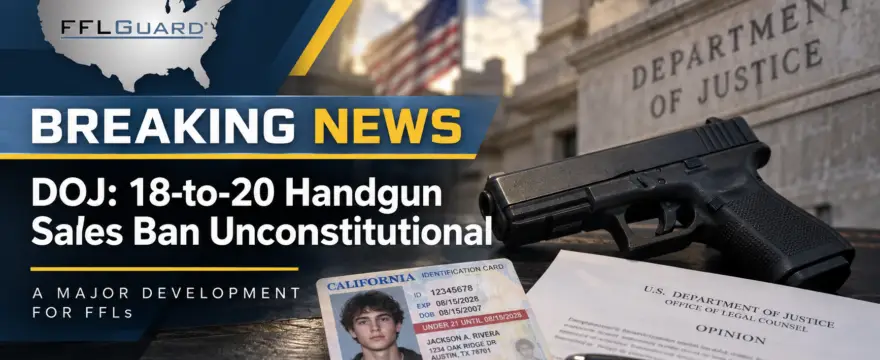
Firearms Action Alert: DOJ Says Federal Under-21 Handgun Sales Ban Is Unconstitutional and Cannot Be Criminally Enforced
Jurisdiction: Federal
Opinion issued: September 17, 2026
Publicly released: September 18, 2026
Status: New—major federal legal and enforcement development; ATF implementation guidance remains outstanding
The Department of Justice has formally concluded that the federal government may not impose criminal penalties on federally licensed dealers for selling handguns to otherwise law-abiding adults ages 18 through 20.
On September 18, 2026, DOJ publicly released an Office of Legal Counsel opinion addressing 18 U.S.C. §§ 922(b)(1) and 922(c)(1). Those provisions have generally prevented an FFL from selling or delivering a handgun to a person the licensee knows or has reasonable cause to believe is under 21.
OLC concluded that applying those restrictions to otherwise lawful 18-, 19-, and 20-year-old adults violates the Second Amendment.
The opinion states that the provisions may not be enforced to impose criminal penalties on dealers who sell handguns to this covered class.
That is a material change in the federal government’s legal and enforcement position. It is not, however, the end of the compliance analysis.
DOJ’s Constitutional Analysis
OLC applied the Second Amendment framework developed through District of Columbia v. Heller, New York State Rifle & Pistol Association v. Bruen and subsequent Supreme Court decisions.
The opinion reached three central conclusions.
First, otherwise law-abiding adults between 18 and 20 are among “the people” protected by the Second Amendment. OLC rejected the proposition that adults in this age group fall outside the Amendment simply because the common law historically treated individuals under 21 as minors for certain purposes.
Second, the acquisition of a handgun falls within the Second Amendment’s protection. Handguns are commonly possessed for lawful purposes, including self-defense, and OLC concluded that preventing an individual from acquiring a handgun necessarily burdens the ability to keep and bear one.
Third, the government could not demonstrate a sufficiently analogous historical tradition supporting a nationwide prohibition on dealer handgun sales to this age group.
OLC emphasized that Founding-era militia laws overwhelmingly required service beginning at age 18 and commonly required militia members to furnish their own arms. The historical record therefore did not establish a tradition of broadly preventing otherwise lawful adults between 18 and 20 from acquiring firearms.
DOJ’s Operative Conclusion
The opinion’s conclusion is direct:
“Section 922(b)(1) and (c)(1) may not be enforced to impose criminal penalties on dealers who sell handguns” to the covered class of otherwise law-abiding adults.
For FFLs, that language matters. DOJ is not merely questioning the policy wisdom of the restriction or announcing that it will exercise temporary prosecutorial discretion. The Department has formally concluded that imposing those criminal penalties would be unconstitutional.
That does not mean the statutory language has disappeared.
Congress has not repealed §§ 922(b)(1) or 922(c)(1). The provisions remain in the United States Code, and the implementing regulations and existing dealer materials have not yet all been revised to reflect DOJ’s new position.
The OLC opinion is also an Executive Branch legal opinion—not a court judgment formally striking the statutory text.
The Dealer-Implementation Gap
There is a meaningful difference between DOJ concluding that it cannot constitutionally prosecute a dealer and ATF completing the operational changes necessary for FFLs to process these transactions normally.
As of this publication, FFLGuard has not identified newly published ATF guidance explaining precisely how dealers should process an 18-, 19- or 20-year-old purchaser seeking to acquire a handgun under DOJ’s new position.
Among the issues still requiring clear operational treatment are:
- how the buyer’s age and firearm type should be handled on the current Form 4473;
- how the transaction should be submitted to and processed through NICS;
- whether existing systems will generate an automatic age-based interruption;
- how the enhanced investigative period for purchasers under 21 applies;
- how ATF will treat these transactions during compliance inspections;
- whether ATF will amend its regulations or published dealer instructions; and
- how dealers should document reliance on DOJ’s opinion.
Until those mechanics are clarified, dealers face an awkward but important distinction: the Department has announced that the covered criminal prohibition cannot constitutionally be enforced, while the existing compliance infrastructure may still reflect the statutory language.
Constitutional thunder has arrived. The revised paperwork has not.
What the Opinion Does Not Eliminate
The DOJ opinion should not be interpreted as eliminating the ordinary requirements governing firearm transfers.
It does not eliminate or suspend:
- completion of ATF Form 4473;
- the NICS background check;
- the enhanced investigative period applicable to certain purchasers under 21;
- the prohibited-person provisions in 18 U.S.C. § 922(g);
- the federal prohibition on handgun possession by persons under 18;
- identification or residency requirements;
- state or local age restrictions;
- state firearm-purchaser permits;
- state waiting periods;
- state background-check requirements; or
- any other federal, state or local requirement applicable to the purchaser, firearm or transaction.
A person being between 18 and 20 years old is not the same as that person being legally eligible to receive a handgun. Every other applicable eligibility and transfer requirement must still be satisfied.
Handgun Ammunition Requires Additional Clarification
Section 922(b)(1) generally addresses both firearms and ammunition and has historically prohibited FFL sales of handgun ammunition to persons under 21. DOJ’s public announcement references that broader statutory restriction.
The OLC opinion, however, expressly states that the question presented was limited to handguns. Its opening and closing operative conclusions specifically address dealers selling handguns to otherwise law-abiding adults between 18 and 20.
The opinion discusses the statutory treatment of ammunition, but it does not state its ultimate conclusion in equally express terms regarding a standalone sale of handgun ammunition.
FFLs should therefore avoid assuming that DOJ or ATF will treat handgun-ammunition-only transactions identically without further guidance.
This is not a semantic technicality. It is the difference between what the statute covers, what DOJ’s announcement describes and what the formal opinion expressly concludes.
State Law Still Controls Independently
DOJ’s opinion addresses the federal restrictions contained in §§ 922(b)(1) and 922(c)(1). It does not invalidate state or local laws imposing their own minimum ages or other conditions on handgun acquisition.
An FFL must still determine whether the purchaser’s state—and, where applicable, the dealer’s jurisdiction—permits the transaction.
State requirements may include:
- a minimum purchase or possession age of 21;
- a permit or license to purchase;
- mandatory waiting periods;
- state-conducted background checks;
- safety-training or certification requirements;
- restrictions on particular handgun models or configurations; and
- additional documentation or reporting.
A change in DOJ’s enforcement position does not preempt those requirements or make them optional.
Recommended FFL Response
Until ATF provides implementation guidance, FFLs should proceed deliberately.
Dealers should:
- Read the DOJ announcement and full OLC opinion—not merely the headline.
- Identify all independently applicable state and local age restrictions.
- Preserve Form 4473, NICS and other transfer requirements.
- Avoid extending the opinion beyond its stated handgun-sale conclusion.
- Monitor ATF communications, published guidance and system changes.
- Document the legal and procedural basis for any policy change.
- Obtain individualized guidance before completing a transaction if the existing forms, NICS response or dealer systems do not align with DOJ’s position.
FFLGuard clients should monitor FFLGuard communications and submit transaction-specific questions through the HelpDesk before changing established procedures or attempting a transaction that existing ATF systems do not process cleanly.
The FFLGuard Bottom Line
DOJ has formally concluded that the federal government cannot constitutionally impose criminal penalties on an FFL for selling a handgun to an otherwise law-abiding adult between 18 and 20 years old.
That is a major federal firearms development.
It is not a repeal of the statutory language, a waiver of Form 4473 or NICS, an override of state law, or permission to treat every remaining implementation question as someone else’s problem.
The federal government has changed its constitutional position. Now ATF must explain how dealers are expected to operationalize it.
Until then, FFLs should recognize the importance of the opinion, preserve every requirement that remains in force and resist the industry’s most expensive compliance habit: filling silence with assumptions.
Official Sources
This alert provides general compliance information based on materials available as of September 18, 2026. It does not constitute individualized legal advice. Federal, state and local requirements should be evaluated before completing any transaction.