
The Short Answer: To renew your Federal Firearms License (FFL), complete and mail ATF Form 8 Part II before your license expires. If the form is postmarked on time, you may request a Letter of Authorization (LOA) to keep operating while your renewal is processed.
If you already have an FFL, you know it doesn’t last forever. Every three years, the Bureau of Alcohol, Tobacco, Firearms and Explosives (ATF) requires you to renew it. This isn’t something you want to put off. A late or incorrect renewal can pause your firearms business or even require you to start over with a new application.
This guide walks you through exactly how FFL renewal works, what documents you need, how to avoid common mistakes, and what to do if your expiration date is near or has passed. We’ll also explain how you can keep your business operations running legally while your renewal is pending.
When and How to Renew Your FFL
Federal Firearms Licenses are valid for a three-year period. As your expiration date approaches, you must renew by submitting ATF Form 8 Part II, the renewal application. The ATF automatically mails this form to the mailing address listed on your current license approximately 90 days before it expires. If you’re not sure what is currently on file with the ATF Federal Firearms Licensing Center (FFLC) for your mailing address, head over to FFL EZCheck to find that information.
It is your responsibility to complete and return this form before your license expires. If you do not receive the form within 30 days of your expiration date, you should immediately contact the Federal Firearms Licensing Center (FFLC@atf.gov). Do not assume the form will show up or that your license will be renewed automatically. ATF does not renew licenses without a completed, submitted, and properly postmarked ATF Form 8 Part II, and once your license has expired, there is no regulatory ability for it to be reinstated. Once it’s gone, it’s gone, and you have to apply for and be granted a new license before any operations may continue.
Per ATF regulation § 478.45, you must submit your renewal application on time to continue operations, which means a correct renewal document with payment and necessary documentation must be in ATF’s hands before the expiration date, beyond your license expiration.
There is no grace period if you miss your expiration date. If the ATF does not receive your renewal application in time, you cannot legally operate as a federal firearms licensee, which means any Special Occupational Tax (SOT) you might hold is immediately invalid, too. You will be required to start over by submitting ATF Form 7 and going through the full application process again, in accordance with § 478.44 of the federal firearm laws. However, if your application is timely submitted and postmarked before expiration, you can legally continue operations as authorized by the expired license even if the ATF has not yet approved the renewal.
Completing and Submitting Form 8 Part II
When you receive ATF Form 8 Part II, carefully review all pre-filled information and make any necessary changes. It is important to verify that the business name, premises address, mailing address, and hours of operation are all accurate and current. If there are required changes to your business name, you will likely need to provide copies of official legal documents to verify the business name update(s).
As a reminder, FFLs are required to notify ATF of any planned changes to the premises address. If your firearms business has moved, you must update your address officially with the ATF via an Application for an Amended Federal Firearm License (ATF Form 5300.38) before submitting your renewal.
You must also ensure the list of Responsible Persons on the license is up to date. If new individuals have joined or others have left since the last time you updated your Responsible Persons for your license, you will need to file additional paperwork to reflect those changes before submitting Form 8.
If your business structure has changed, such as converting from a sole proprietorship to an LLC or corporation, your renewal may not be valid. Any business structure changes should be reported to ATF via an Application for an Amended Federal Firearm License (ATF Form 5300.38). Structural changes to the legal entity often require a new license application. This is another reason it’s important to thoroughly review your documents before assuming you can simply renew.
Checklist before mailing your renewal:
- Ensure correct renewal fee and payment method are included (ranges from $90 to $3,000)
- Verify information is current, accurate, and complete:
- Licensee name
- If changes are needed, determine if you need to file an Application for an Amended Federal Firearm License (ATF Form 5300.38), and submit as necessary.
- Trade name (if any)
- If changes are needed, determine if you need to file an Application for an Amended Federal Firearm License (ATF Form 5300.38), and submit as necessary.
- Premises address
- If changes are needed, determine if you need to file an Application for an Amended Federal Firearm License (ATF Form 5300.38), and submit as necessary.
- Mailing address
- Hours of operation
- Phone number(s)
- Email address
- Licensee name
- Confirm all Responsible Persons are current
- If changes are needed, ensure proper documentation is submitted
- Make copies of the complete renewal packet to be submitted for your files
- Use certified or tracked mail for proof of submission and validation of receipt
- Send your completed and signed form, along with payment, to the address provided in the instructions.
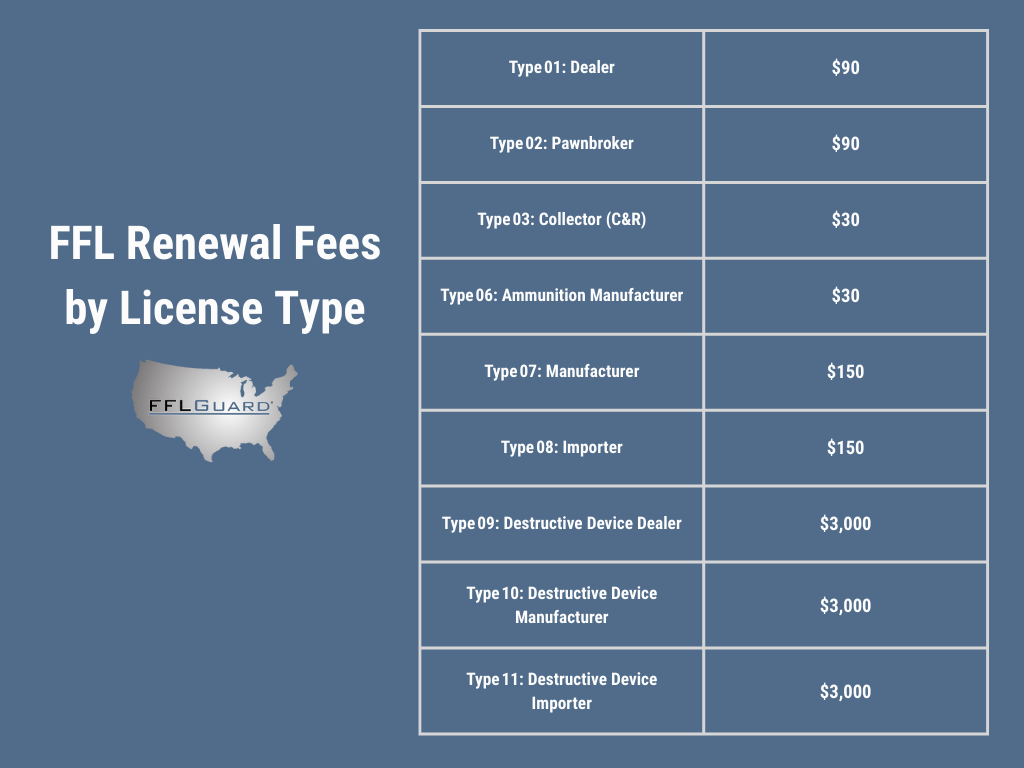
What Happens After Submission
Once ATF receives your renewal application and payment, processing begins. This process can take several business days, and sometimes up to 60 days, depending on ATF’s current workload and the specifics of your license. Upon receipt, payment is drawn and validated. If your payment cannot be processed, your renewal application will NOT be processed. Upon payment completion, your application is reviewed to confirm that you are in continued compliance with all applicable federal firearm laws.
Note that processing times may increase significantly in the coming years due to recent federal budget cuts that have reduced ATF staffing levels, potentially extending standard processing timeframes.
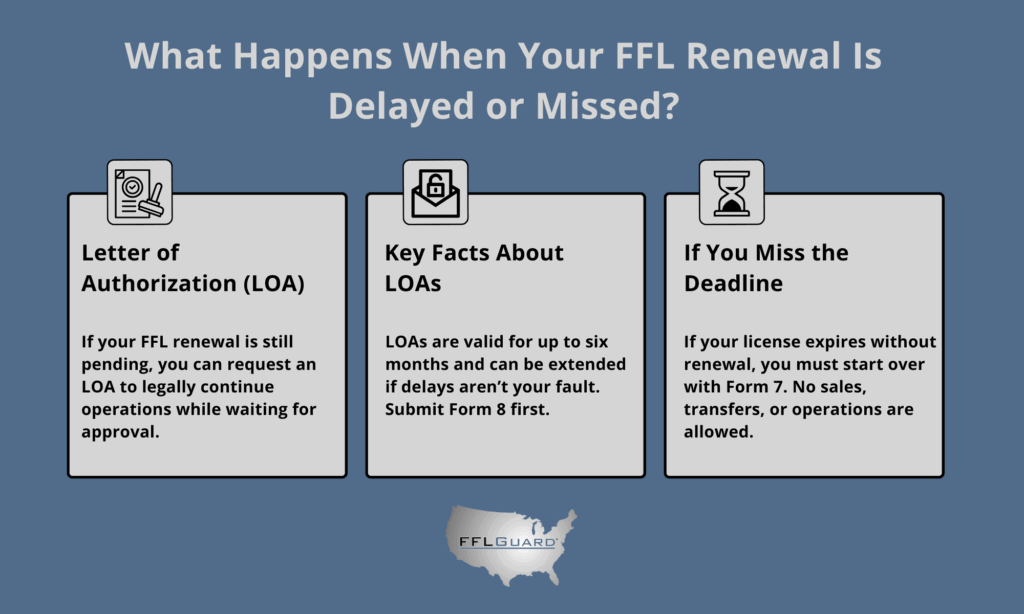
If your license is close to expiring and your renewal has not yet been approved, you may request a Letter of Authorization (LOA) from the FFLC. This document allows you to continue business operations legally while your application is pending. It also serves as evidence for your suppliers and distributors that you are permitted to conduct licensed activities despite your license appearing expired in the ATF system.
Key facts about the LOA:
- Must be requested after submitting a timely Form 8
- Valid for up to six months beyond license expiration
- Can be extended if delays are not your fault
- Useful for continuing transfers, orders, and operations
- Issued solely at the discretion of ATF FFLC
Distributors and partners may ask for a copy of your LOA before fulfilling orders or initiating firearm transfers. Make sure to keep copies readily available and provide them as needed to avoid business interruptions.
What If You Miss the Renewal Deadline?
If ATF does not receive your Form 8 before your license expires, you are no longer legally authorized to engage in any of the activities covered by your license. This includes selling, manufacturing, importing, or transferring firearms and ammunition as a certified licensee, even if your firearms business remains operational.
Once a license expires, it cannot be retroactively renewed. Instead, you must begin the licensing process from the beginning by submitting ATF Form 7, the standard application for a new license. You must also pay the full application fee, which can be more costly than a renewal. ATF will treat this as an entirely new license application, meaning that all previous compliance inspection records, approvals, and background check documentation will not automatically carry over.
During the time between expiration and the issuance of a new license, you may not legally engage in business activities in the scope of your former FFL. This can have major implications for inventory management, storage, and contractual obligations with partners under federal law.
Common Mistakes and How to Avoid Them
Many federal firearm licensees make preventable errors during the renewal process. These mistakes can cause delays, denials, or even legal issues that could have been avoided with proper planning.
Top mistakes to avoid:
- Waiting too long to start the renewal process
- Submitting outdated business or Responsible Person info
- Failing to update the ATF when business changes have been made before filing Form 8
- Forgetting to request an LOA if your expiration is near
- Ignoring previous ATF violations or unresolved compliance issues
The most common mistake is waiting too long. If you leave it until the last few weeks, you run the risk of missing the deadline due to mail delays, incomplete paperwork, or forgotten details.
Licensees also sometimes forget to request an LOA while waiting for their renewal to be processed. This oversight can lead to unnecessary business shutdowns if the license expires before the new one is issued.
Ignoring past compliance issues is another risk. If you have received any warnings, notices of violations, or inspection findings from the ATF or a law enforcement agency, address them before submitting your renewal. The ATF considers your full compliance history when evaluating renewals, and unresolved issues may delay or jeopardize approval.
FFLGuard’s Role in Renewal Support
FFLGuard offers support services for licensees that helps prevent problems during the renewal cycle and throughout your license term. We offer tools and guidance that simplify the process and help you stay compliant with ATF expectations.
As your expiration date nears, FFLGuard helps by reminding you of your renewal window and walking you through what needs to be done. The team can review your Form 8 to check for issues before you submit it. If you’ve had prior compliance issues or received letters from the ATF, FFLGuard can help you address them before they affect your renewal.
FFLGuard also assists with preparing and requesting LOAs, updating Responsible Persons, and maintaining documentation. Their legal support can be useful if ATF delays processing or if your renewal is denied and you need to appeal or reapply. For many licensees, having expert help on call provides peace of mind during an otherwise stressful administrative process. Join FFLGuard to learn more about our service plans and contact us with any questions.