
At a Glance: While there have been legislative efforts to remove suppressors from the NFA, including the Hearing Protection Act (HPA), they have not been fully deregulated. The $200 tax stamp was eliminated on January 1, 2026, but suppressors will remain subject to NFA registration and approval.
Firearm suppressors or silencers as they’re referred to in regulations, are regulated under the National Firearms Act (NFA). But will they be removed from the NFA, making them like any other firearm? This question has sparked debate among gun owners, advocates for the Second Amendment, and lawmakers alike.
Suppressors are designed to reduce the noise (or “report”) generated by firearms, primarily for hearing protection. However, purchasing a suppressor comes with significant regulatory hurdles. Under the NFA, suppressors are classified as NFA items, requiring gun owners to undergo a time-consuming process, including a background check, Bureau of Alcohol, Tobacco, Firearms and Explosives (ATF) registration, and ATF approval to move or transfer the item.
So, what does the future hold for suppressors? Will they continue to be regulated under the NFA, or is deregulation on the horizon? Let’s dive into the legislative efforts and the potential changes to NFA regulation.
What is the National Firearms Act (NFA)?
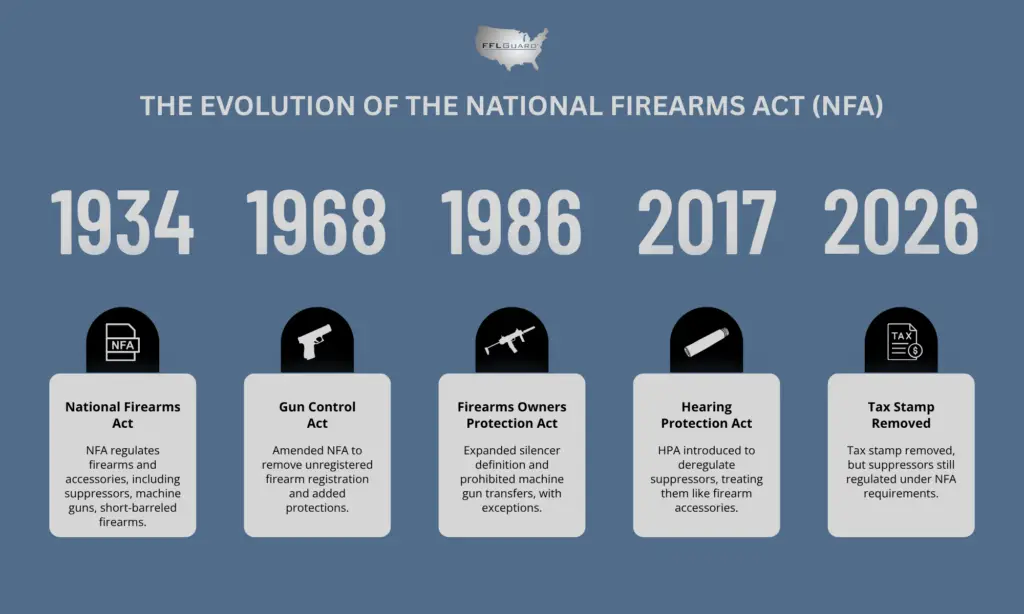
The National Firearms Act (NFA) was passed in 1934 as a way for the federal government to regulate certain firearms and firearm accessories. The purpose was to address concerns about violence and criminal use of firearms considered to be rampant during the Prohibition Era by making it difficult and expensive for civilians to legally possess certain weapons, such as machine guns, short-barreled rifles (SBRs), short-barreled shotguns (SBSs), certain firearms with hidden/concealed appearance (any other weapon), and firearm suppressors.
Regulation of Suppressors
Suppressors fall under the NFA and are classified as firearms. That’s right – a suppressor is a “firearm” in the eyes of the National Firearms Act. To legally possess a suppressor (by purchase, gift, or any other transfer), the receiver must submit an ATF Form 4, and pass a background check. The $200 tax stamp was discontinued on January 1, 2026, but all of the regulations to make, purchase, move, or transfer remained intact. These regulations have made suppressors difficult for some law-abiding citizens to obtain.
The NFA’s primary goal was to regulate firearms and firearm accessories that could be easily concealed or were perceived as particularly dangerous. Suppressors were included due to concerns about their potential use in criminal activities. Many argue these concerns were misplaced and resulted from a common misconception that a suppressor fully “silences” the sound of a firearm. In reality, the sound is merely suppressed to a level that, in most cases, would not cause damage to a normal adult’s hearing. This means their primary function is not truly for covert firearm activity, but to protect hearing, one of the few organs medical science has not been able to restore or replace if damaged. This makes suppressors continued regulation a point of contention among many gun rights and hearing protection advocates.
Legislative Efforts to Deregulate Suppressors
One of the most significant legislative efforts to deregulate suppressors was the introduction of the Hearing Protection Act (HPA). This bill aimed to remove suppressors from the NFA entirely, making them as accessible as any other firearm accessory.
The HPA was first introduced in 2017, with the goal of deregulating suppressors by removing them from the NFA. It gained momentum among lawmakers, especially following the support of Second Amendment advocates and groups like the National Rifle Association (NRA), Second Amendment Foundation, and Firearms Policy Coalition.
Key Supporters:
- President Trump voiced his support for the bill, with many Republican lawmakers also backing the HPA, citing the importance of hearing protection for gun owners.
- Support came from gun rights organizations that argued that suppressors should not be heavily regulated when they are primarily used to protect hearing.
Challenges in Legislation
Despite widespread support, the HPA has faced significant challenges in Congress. Political opposition, competing priorities, and a divided Congress have prevented the bill from passing.
Byrd Rule
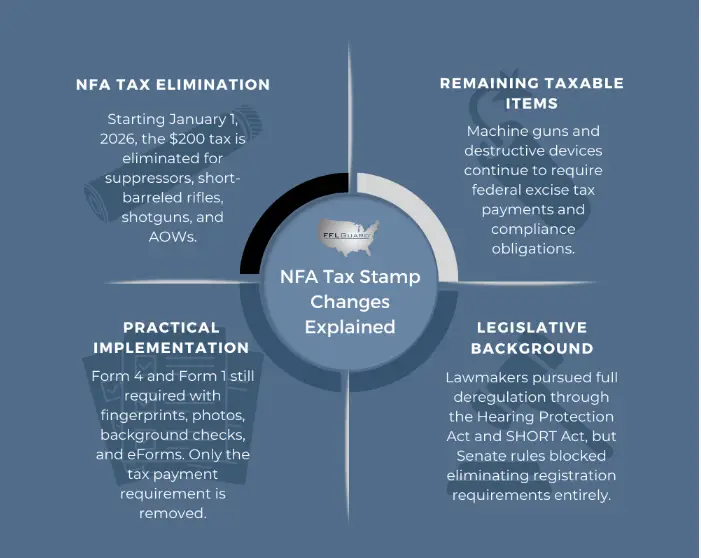
In the legislative reconciliation process, the Senate Parliamentarian applied the Byrd Rule, which prohibits extraneous policy changes in budget reconciliation bills. This decision blocked the full deregulation of suppressors, as it was deemed unrelated to the budget.
Opposition from Gun-Control Groups
Opponents, such as Everytown and Giffords, argue that removing suppressors from the NFA would undermine public safety and make it harder for law enforcement to track firearms. They maintain that suppressors could be misused in criminal activities.
How the NFA Tax Stamp for Suppressors Was Removed
The tax stamp has long been a financial burden for gun owners seeking suppressors. The $200 tax stamp remained unchanged from its initial requirement in 1934 to its discontinuation for certain NFA firearms in 2025 (to put that in perspective, $200 in 2025 was equivalent to about $4,530 in 1937). Many have argued that it acts as an unnecessary barrier for law-abiding gun owners seeking suppressors for legitimate uses.
Recent Legislative Change (2025)
In May 2025, the Big Beautiful Bill (H.R.) was passed, which eliminates the $200 tax stamp requirement for suppressors starting January 1, 2026. This change, however, does not remove suppressors from the NFA’s regulatory framework.
The reconciliation bill dictates that the transfer tax was removed on January 1, 2026, making suppressors more accessible by lowering the financial barrier to ownership.
This change reduced the cost of purchasing suppressors, making them more accessible to gun owners. However, the registration requirement and background check still apply, so while the tax stamp is removed, the NFA’s control over suppressors remains intact.
The elimination of the transfer tax makes it easier for gun owners to obtain suppressors without the added financial burden. However, the ATF Form and the registration requirement remain, meaning the suppressor still falls under NFA regulation, but with a simpler process.
Lawsuits Challenging NFA Requirements
Recent ATF defenses of suppressor registration have focused on upholding the National Firearms Act (NFA) as a constitutional “shall-issue” system, even as recent legal challenges, such as Roberts v. ATF (2026), argue that the removal of associated taxes renders registration unconstitutional. The U.S. Department of Justice (DOJ) maintains that NFA requirements for suppressors remain valid under congressional authority, despite evidence of subjective, discretionary denials on application forms.
Key recent developments regarding the ATF and silencer registration include:
Constitutional Challenges (2026): Multiple lawsuits, including Brown v. ATF, Jensen v. ATF, and Roberts v. ATF, have been filed to challenge the NFA’s registration scheme, arguing that because the tax on suppressors has been eliminated, the remaining registration requirement serves no constitutional purpose and violates the Second Amendment.
Evidence of Discretionary Denials: Plaintiffs in current lawsuits have introduced evidence showing that the ATF has denied Form 1 applications based on subjective criteria—such as a user’s stated reason to “exercise my God-given rights”—rather than objective standards.
Congressional Feedback after One Big Beautiful Bill: On November 10, Rep. Clyde and 19 other members of Congress sent a letter to AG Bondi, urging her and others in the administration to align with Congressional intent to remove NFA registration requirements.
Defense of the NFA (2025-2026): The Department of Justice (DOJ) continues to defend the NFA in court, arguing the registration system is a lawful “shall-issue” mechanism, even though plaintiffs argue that subjective denials turn this into a forbidden discretionary system.
Legal Precedent (United States v. Peterson): In a key 2025 decision, the Fifth Circuit Court of Appeals affirmed that the NFA’s registration and licensing requirements for suppressors are constitutional and upheld convictions for possessing unregistered items.
Regulatory Disputes (2023-2025): Although a U.S. District Court previously vacated ATF Final Rule (2021R-05F), ruling that the agency acted in excess of its statutory jurisdiction, as of March 2026, the Supreme Court in Bondi v. VanDerStok (formerly Garland v. VanDerStok) upheld the ATF’s 2021 Final Rule (2021R-05F) on “ghost guns” in a 7-2 decision, ruling that the regulation of weapon parts kits and unfinished frames/receivers does not violate the Gun Control Act. The ruling reversed lower court decisions that had previously vacated the rule, allowing the ATF to enforce, requiring serial numbers on kits
Why Full Removal from the NFA Hasn’t Happened Yet
The full removal of suppressors from the NFA remains a complex issue due to various political and legislative hurdles.
- Byrd Rule: The Byrd Rule played a pivotal role in preventing full deregulation of suppressors. This rule prevents extraneous policy changes in budget bills, preventing the inclusion of suppressor deregulation in recent legislative efforts.
- Senate Opposition: While many lawmakers support deregulation, the Senate has blocked efforts to fully remove suppressors from the NFA. This has primarily been due to the concern that it could create complications in tracking firearms and lead to misuse.
- Political Landscape: The current political climate and the federal government’s stance on firearms regulation have made it difficult to gather sufficient support for the full deregulation of suppressors. The Second Amendment debate plays a significant role in shaping these discussions.
- Timing Issues: Future elections could shift the balance of power in Congress, potentially leading to more favorable conditions for suppressor deregulation. However, the process remains uncertain.
- DOJ Support: As of the date of publication of this post, the DOJ continues to actively assert their authority and continued implementation of all requirements for registration, transfer, etc. of all NFA items, including suppressors.
What Would Removing Suppressors from the NFA Mean?
If suppressors were removed from the NFA entirely, the process of purchasing a suppressor would be like purchasing any Gun Control Act (GCA) regulated firearm.
Impact on Gun Owners:
- No special ATF Form, fingerprints, pictures, etc. for registration and transfer.
- Routine ATF Form 4473 process with background check (and compliance with any state and local regulations) for firearm transfer and possession.
- It would create a more straightforward process for law-abiding citizens who wish to own suppressors for hearing protection and other legitimate uses.
Impact on Law Enforcement:
- Law enforcement may face difficulties in tracking suppressed firearms that are legally registered. However, according to NSSF, available data does not support this claim, reporting that from 1995-2005 only in only fifteen (15) federal cases were suppressors actually used in the commission of the alleged crime, while there were about 50,000 suppressors registered (0.03%),
- Concerns about potential misuse, especially if it becomes easier for criminals to acquire suppressors.
Impact on FFLs:
- Simplified Sales Process: If suppressors were removed from the NFA, FFLs would no longer need to process NFA paperwork or handle forms specifically for NFA items, streamlining the purchasing process.
- Increased Sales Potential: With fewer regulatory hurdles and reduced labor investment, FFLs could see an increase in customer interest and suppressor sales, as the process would be similar to buying other firearms.
State vs. Federal Law:
- Even if federal law changes, state laws may still impose restrictions. This would create a complex situation where some states allow suppressor ownership while others regulate or ban them.
FFLGuard: Your Partner in NFA Compliance
As suppressor regulations evolve, gun owners must stay informed and adapt to the changes. While the removal of the $200 tax stamp is a step in the right direction, full deregulation is not imminent. It’s important to remain aware of future legislative trends and be ready for the regulatory shifts that could impact suppressor ownership.
Partner with FFLGuard to navigate these shifts in the regulatory environment. Our legal expertise and proactive compliance services keep you ahead of changing laws and regulations.
Expert Legal Interpretation and Real-Time Advice: FFLGuard’s 24/7 Legal HelpDesk connects you with experienced firearms attorneys and former ATF personnel who can help interpret legal updates, clarify your responsibilities, and ensure you remain compliant through regulatory changes.
Proactive Compliance Roadmaps (LPGs): Law Plus Guidelines walk you through documenting inventory, updating SOPs, and training staff to meet ATF requirements.
Ongoing Alerts on Rulemaking & Appeals: FFLGuard’s insider-level monitoring keeps you updated on changes, so you can adjust practices before official changes take effect.
With FFLGuard, you’re not reacting, you’re staying ahead of the curve. Our comprehensive legal team ensures your operations remain compliant and secure as suppressor regulations evolve.
Contact FFLGuard today to learn more about our services and stay ahead in this shifting regulatory environment.