
Because “we’ll update ATF after the move” is how people end up starring in their own compliance documentary.
If you’re changing locations, here’s the deal: ATF doesn’t care that your lease starts Friday. They care where regulated activity happens—and your license is tied to the premises address. Move wrong, and you can accidentally “move” yourself straight into an enforcement problem.
Let’s keep this tight.
What Counts as an FFL Address Change
Not every “address update” is treated the same. ATF focuses on where firearms business activity takes place. That’s the whole ballgame.
Premises Address vs. Mailing Address (Stop Mixing These Up)
Premises address = the physical location where you conduct business and handle firearms. It’s printed on your license, and for manufacturers/importers it’s typically tied to the city/state marking requirements on firearms.
Mailing address = where ATF sends letters and paperwork. Updating your mailing address does not authorize you to store, transfer, manufacture, or receive firearms at a different location.
Both show up on ATF paperwork, and that’s why people get confused. But only one controls where you can actually do business:
The premises address. Period.
Storage Locations and Off-Site Addresses
This is where “good intentions” turn into “bad outcomes.”
Off-site storage can be allowed in limited, storage-only situations—but it has to be set up correctly. Do not assume you can store or receive firearms anywhere that isn’t on the license.
Common misconceptions that get FFLs jammed up:
- “Temporary storage doesn’t need ATF involvement.”
- “It’s my house—of course I can store inventory there.”
- “We’re just receiving shipments at the new place for convenience.”
- “Off-site storage isn’t subject to inspection.” (Spoiler: it is.)
Federal and state law both matter here, and these issues often don’t blow up until later—like during an inspection, when “we thought it was fine” becomes a very expensive sentence.

Changing the Premises Address: This Is Not a Cute Admin Update
A premises address change is a license event. Mishandle it and you can put your whole operation on pause—fast.
Before You Pick a New Location…
All requirements still apply at the new address: zoning, permits, lease language, security/storage, and local approvals.
If you don’t vet the location first, you’re basically buying a ticket for delays (or denial).
(FFLGuard note: this is exactly why we hammer zoning and local compliance early—because nothing ruins a move like finding out you can’t legally operate there.)
The 30-Day Rule (Read This Twice)
Per ATF Form 5300.38 (Revised September 2023) instructions, you must notify The Bureau of Alcohol, Tobacco, Firearms, and Explosives (ATF) no less than thirty (30) days prior to establishing operations at the new address.
And “notify” doesn’t mean “we told an IOI on the phone” or “we emailed someone we found online.”
It means:
✅ A complete, correct ATF Form 5300.38
✅ Submitted properly, per the form instructions
✅ At least 30 days before you start operating at the new location
Operating—manufacturing, transferring, receiving—at a new address without following proper protocol is a federal violation. And no, that story never has a happy ending.
Steps to Change Your FFL Address With ATF (How It Works in Real Life)
When ATF Notification Is Required
Notification is required before:
- Operating at the new address (including manufacturing)
- Completing any firearm transfer at the new location
- Receiving any incoming transfer at the new address
Only the licensed premises authorizes firearms business activity. Storage outside the licensed premises requires extra care and is only allowed in limited situations.
Application Process and Timing
Address changes are handled through ATF Form 5300.38. Often it’s processed as an amendment—but not always.
Plan for this:
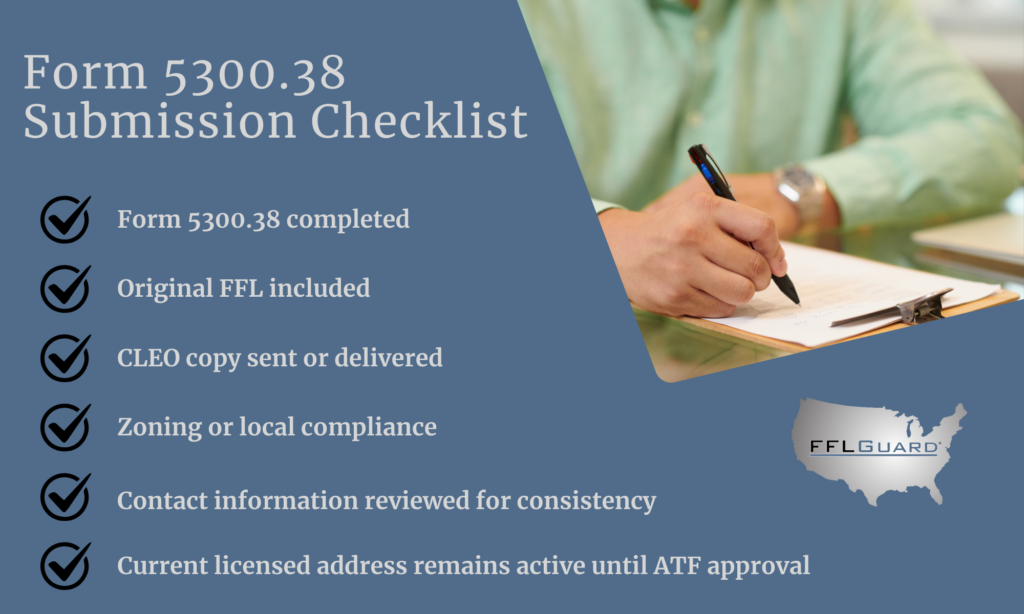
- ATF Form 5300.38 must be submitted with your original FFL for the address to be updated
- It must be signed by a current, active Responsible Person
- A completed copy must be sent or delivered to the local CLEO where the new premises is located
- Processing time varies—count in calendar days, not wishful thinking
- Delays are common when zoning documentation is missing or incomplete
- ATF may determine a new FFL is required, and you’ll have to apply accordingly
Manufacturers/Importers:
Your city/state location is often part of required firearm markings. When you move, you must update markings appropriately—but not before you’re approved to operate at the new premises.
Local Zoning and Premises Review
ATF typically verifies zoning compliance at the new address. Missing zoning letters or special approvals can stop the process cold.
This is the most underestimated step in the move. And it’s why “we found a great spot” can turn into “we’re stuck” for months.
Can You Keep Operating While Moving?
In most cases, yes—you can keep operating at the old address until ATF issues the amended license.
Generally allowed during transition:
- Transfers at the current licensed address
- Receiving firearms at the current address
- Normal business operations, including manufacturing, at the current address
Not allowed:
- Transfers at the new address
- Manufacturing at the new address
- Changing markings to reflect the new address
- Treating the new location like an active premises before approval
ATF can (and does) review activity near the transition period later. If your records show “creative timing,” expect questions.
Recordkeeping During an FFL Move
Moves don’t excuse messy records. And ATF loves records.
A&D + 4473 Continuity
Your A&D records should reflect activity based on the licensed address in effect at the time, and your ATF Forms 4473 should match the FFL address in effect at the time.
Best practices:
- Avoid gaps or duplicate entries
- Document inventory movement
- Retain transfer/movement receipts
- Do not change FFL address/number on ATF Forms 4473 until you’re operating at the new premises
Also: if a move triggers changes with POC agencies / FBI NICS logins, handle that early.
Never run a background check under an FFL number not associated with the premises where the transaction is occurring.
ATF Form 4473 Storage and Accessibility
Your ATF Forms 4473 must remain:
- Secure (PII protected)
- Properly stored and filed per regulations
- Accessible for inspection—even if you’re mid-pack
No, you can’t “misplace them during the move.” And no, you can’t destroy anything.
If a new FFL is being issued, you may have additional regulated-record transfer requirements (including OBRC rules) that must be handled correctly and on time.
Transport, Storage, and Security During the Move
Moving firearms is not like moving office chairs.
Plan for:
- Secure transport with gun-to-book / book-to-gun inventories at origin and destination
- Carrier tracking with no markings on packaging indicating firearms
- If you’re not using a common carrier: route, security, follow vehicles, and inventory procedures need to be thought through
- Don’t keep using shipping labels tied to an old address once approval is pending
- Notify vendors/subcontractors of the new premises address + effective date, and provide the amended/new FFL ASAP
Loss or theft during a move can trigger ATF attention and scrutiny of your business practices—fast. ATF often immediately arrives on-site after a theft/loss report to do a complete inventory reconciliation and/or inspection.
Common Address-Change Mistakes That Trigger ATF Problems
Most issues come from assumptions, not bad intent.
Classic mistakes:
- Moving firearms before ATF notification / license amendment
- Operating from an unapproved premises
- Receiving incoming transfers or manufacturing too early
- Assuming a mailing address update is sufficient
- Overlooking zoning/leasing requirements
- Forgetting to update markings (manufacturers/importers)
- Failing to update contact info consistently across systems
Even experienced FFLs step on these rakes. Don’t be the next one.
When to Talk to a Firearms Attorney
Some moves are simple. Some are landmines.
Get legal guidance when:
- Business structure is changing
- You’ve got scheduled transfers during the move window
- Prior compliance issues exist
- Storage/shared-space questions come up
- You’re moving across regions/states or suspect a new FFL will be required
An early review can prevent late-stage disasters.
How FFLGuard Helps With an Address Change
FFLGuard supports FFLs through address changes as part of our cooperative legal and compliance program—because moves touch everything: licensing, transfers, records, storage, and operational timing.
We help clients:
- Understand what ATF will require for your type of move
- Review and sanity-check ATF Form 5300.38 details
- Plan operations during the transition (without creating compliance landmines)
- Build a move timeline that doesn’t interrupt business more than necessary
And if an address change leads to ATF scrutiny? Our firearms attorneys step in—nationwide—supporting clients through inspections, warning conferences, and follow-up actions tied to the move
The FFLGuard Bottom Line
Moving your FFL isn’t hard. It’s just procedural—and ATF is a “procedure people.”
Do it right:
- Vet the new location (zoning/permits/lease/security)
- File correctly and early
- Don’t operate at the new place until approved
- Keep records clean and consistent
- Move inventory like it matters—because it does
Ready to do it without drama?
Contact FFLGuard today for personalized support with your FFL application or compliance strategy and Find Your Plan to join the nation’s leading network of protected Federal Firearms Licensees.
(This is general information and not legal advice. For situation-specific guidance, especially multi-location or cross-jurisdiction moves, get counsel.)