
Getting a federal firearms license (FFL) in New Jersey takes more than just filing a federal application. You must complete both federal and state-level approvals, and in this state, even a judge signs off on your license.
New Jersey is one of the most regulated states for gun dealers in the United States. You will need approval from the Bureau of Alcohol, Tobacco, Firearms and Explosives (ATF), your local authorities, the state police, and the court system. That adds time, cost, and more paperwork than most states.
If you plan to run a firearms business, open a gun shop, or handle FFL transfer services, this guide walks through each step so you know what to expect.
Getting an FFL in New Jersey
Here is the full process broken down into simple steps:
- Meet federal eligibility requirements
- Secure zoning approval in your town
- Submit your ATF form application
- Complete the ATF interview and background check
- Apply for the New Jersey Retail Dealer License
- Get approval from a Superior Court judge
- Complete onboarding with the New Jersey NICS system

Step 1: Make Sure You Meet Federal FFL Requirements
Before applying, you must meet basic federal law requirements.
Applicants must:
- Be at least 21 years old
- Be a United States citizen or a lawful permanent resident
- Be legally allowed to possess a firearm and ammunition under federal law
- Operate from a physical business location suited for firearm storage and transactions
- Meet all federal requirements for zoning and business activity
- Hold a lease or property agreement that allows firearm-related business activity
- Complete a background check during the application process
- Have a clear intent to operate as a licensed dealer or manufacturer once approved
Applicants must NOT have:
- Felony convictions or offenses punishable by more than one year of confinement, even if you got a lesser sentence
- Substance abuse issues, including the use of marijuana under state laws
- Disqualifying mental health adjudications
- Outstanding arrest warrants
- Pending criminal charges or open cases
- A dishonorable discharge from the Armed Forces
The ATF also requires you to list all responsible parties. These are anyone involved in the business who has control over operations or inventory.
If you are entering the industry as a first-time buyer, this is where many people get filtered out. The ATF looks for business intent, not hobby activity.
Step 2: Confirm New Jersey Zoning and Business Compliance
Zoning is one of the biggest hurdles in the state of New Jersey.
Before you submit anything, you need approval from your local municipality. Without it, your application will not move forward.
Here is what to know:
- Your location must be approved for a dealer business
- Many towns restrict or deny home-based FFLs
- Local officials often review your setup before approval
This step can stop your application before it starts.
You also need to:
- Register your business in New Jersey
- Set up a compliant place to store and manage each firearm
- Follow local rules tied to retail or commercial activity
If your goal is to run a small home operation, understand that many areas in New Jersey do not allow it.
Step 3: Complete ATF Form 7 and Submit Your FFL Application
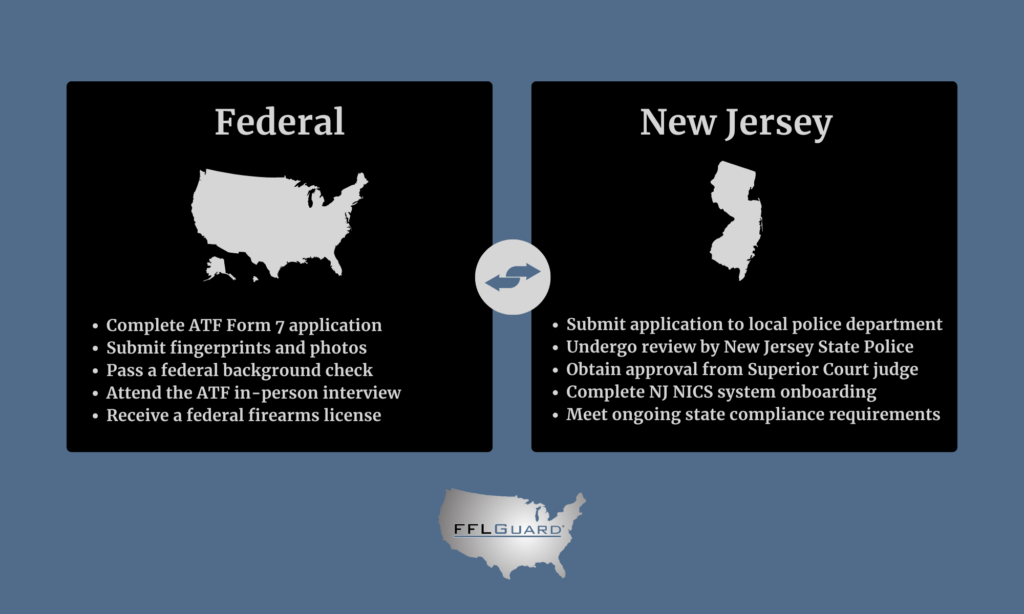
Next, you will complete your federal application using ATF Form 7.
This includes:
- Business information
- Responsible persons
- Fingerprints and photos
- Application fees
FFL License Costs:
FFL Type | Application Fee | Renewal Fee (3 Years) |
Type 01 | $200 | $90 |
Type 02 | $200 | $90 |
Type 03 | $30 | $30 |
Type 06 | $30 | $30 |
$150 | $150 | |
Type 08 | $150 | $150 |
Type 09 | $3,000 | $3,000 |
Type 10 | $3,000 | $3,000 |
Type 11 | $3,000 | $3,000 |
You must also notify your local Chief Law Enforcement Officer.
Accuracy matters here. Missing or incorrect paperwork will delay your approval.
Step 4: Pass the ATF Background Check and Interview
After submitting your application, the ATF begins its review.
This includes:
- A full background check
- An in-person interview with an Industry Operations Investigator
During the interview, they will review:
- Your business plan
- Your understanding of compliance
- Your setup for handling a firearm sale and transfer
Be ready to explain how you will operate as a licensed dealer and follow all federal and state requirements.
Step 5: Apply for Your New Jersey Retail Firearms Dealer License
In New Jersey, your federal license is only part of the process.
You must also apply for a state-level dealer license.
Here is how it works:
- Submit your application through your local police department
- If your town has no local department, apply through the state police
- Your application is reviewed by the New Jersey State Police
- Final approval is issued by a Superior Court judge
This step makes New Jersey different from most states.
Costs are lower on paper, usually around $50, but delays are common. Court scheduling and local review can extend your timeline.
Step 6: Complete NJ State Police NICS Onboarding
New Jersey uses its own system for background checks.
You cannot simply sign up online.
Instead:
- You must be approved and onboarded by the New Jersey State Police
- Access is granted after your licensing process is complete
- This system is required for most retail firearm transfers conducted by a dealer
Nearly every retail firearm transfer and sale goes through this system.
What Type of FFL Do You Need in New Jersey?
Most applicants only need one type of license.
Here are the common options:
- Type 01 FFL
- Used by most gun dealers
- Allows retail sales, transfers, and basic operations
- Type 07 FFL
- Used for manufacturing firearms
- Needed if you plan to build or modify weapons
In most cases, a New Jersey FFL applicant will use a Type 01 license along with the state dealer license.
How Much Does It Cost to Get an FFL in New Jersey?
Costs go beyond the application fees.
Here is a realistic breakdown:
- Federal license: $30 to $200
- State dealer license: about $50
- Fingerprinting and photos
- Business registration costs
There are also additional fees that catch many applicants off guard:
- Legal or business formation help
- Insurance for your business
- Security upgrades for your location
- Storage and safety setup
Costs vary based on your setup and location.
How Long Does It Take to Get an FFL in New Jersey?
Timelines are longer than most states.
Typical process:
- ATF review: about 60 days
- state review and court approval: adds more time
Most applicants should expect:
- 3 to 6+ months total
Delays often come from:
- Local zoning approvals
- State review timelines
- Court scheduling
If you plan a future purchase or business launch, build in extra time.
New Jersey Gun Laws You Must Follow as an FFL
Operating in New Jersey means following strict state laws.
Here are some of the main ones:
- Buyers must have a Firearms Purchaser Identification Card (FPID) for long guns
- Separate handgun permits are required for each handgun
- Limit of one handgun purchase every 30 days
- All sales require a background check
- Certain assault weapon types are restricted
- Certain firearm features and configurations are restricted under New Jersey law
You must also manage records:
- ATF Form 4473 for every transaction
- Bound book records for every sale and transfer
Every FFL dealer is expected to follow both federal and state rules at all times.
Common Mistakes When Applying for an FFL in New Jersey
Many applications get delayed or denied due to avoidable issues.
Watch out for these:
- Skipping zoning approval
- Not understanding state-level requirements
- Applying without a real business plan
- Submitting incomplete paperwork
- Failing to prepare for the ATF interview
New Jersey adds extra layers compared to other states, so preparation matters.
How FFLGuard Supports New Jersey FFL Dealers
FFLGuard’s legal and compliance program has supported firearm businesses across the United States since 2008. The program is guided by The Chiafullo Group, LLC, and brings together attorneys and industry professionals who focus on helping a federal firearms license holder protect their business and stay aligned with both federal and state rules.
If your business is reviewed by regulators or law enforcement, FFLGuard provides legal defense and guidance throughout the process. New applicants also receive support during setup. This includes help organizing your firearms business, preparing for your first audit, and building a system that works from day one.
If you are ready to apply for your New Jersey FFL, FFLGuard can help you move forward with more confidence. Contact FFLGuard today or explore available plans to get started.
FAQs About Getting an FFL in New Jersey
In some cases, yes. Approval depends on local zoning. Many municipalities restrict home-based operations, so you need written approval before applying.
Yes. You must have a federal license and a New Jersey Retail Firearms Dealer License to operate legally.
No. The ATF requires that you operate as a business. A license is not issued for personal collection purposes.
A New Jersey resident needs a Firearms Purchaser Identification Card (FPID) for long guns and separate permits for each handgun purchase.
An FFL dealer handles firearm transfers, retail sales, recordkeeping, and compliance between buyers and sellers.