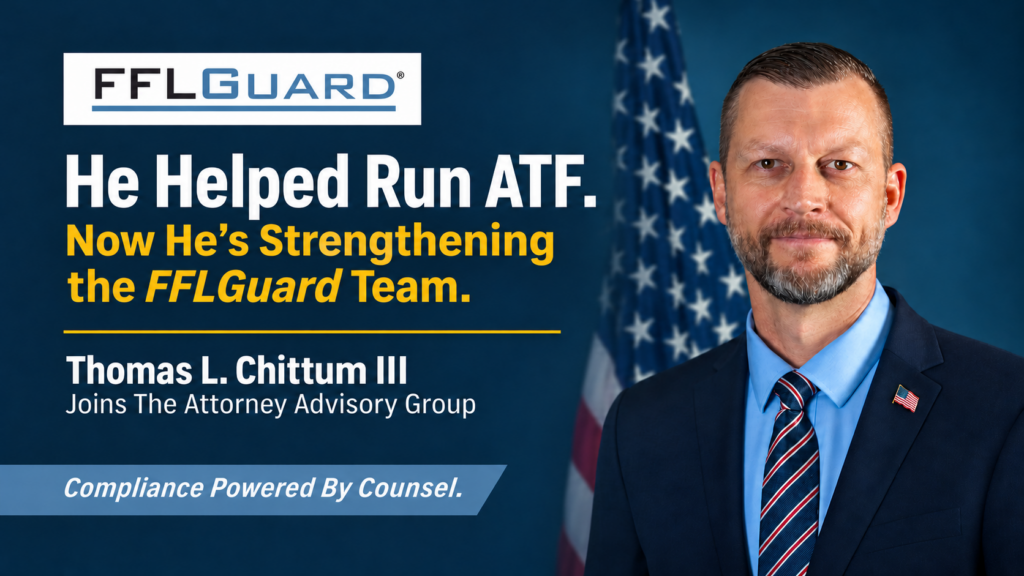
FFLGuard is pleased to announce that Thomas L. Chittum III—former Associate Deputy Director and Chief Operating Officer of the Bureau of Alcohol, Tobacco, Firearms and Explosives (ATF)—has joined FFLGuard’s Attorney Advisory Group.
Chittum retired from the Department of Justice in 2022 after nearly 27 years of federal service. His leadership positions included Acting Deputy Director and Assistant Director of Field Operations, overseeing ATF’s investigative, law enforcement and regulatory field operations nationwide. Today, he practices through Chittum Law, PLLC, and teaches Firearms Law & the Second Amendment at the University of Nevada, Las Vegas William S. Boyd School of Law.
“Knowing what ATF usually asks our clients is useful. Understanding how the ATF makes decisions—and having counsel prepared to challenge those decisions—is another level of preparation,” said Alexis Tunell, FFLGuard’s Director of Operations. “Tom brings national ATF leadership experience and a practicing attorney’s judgment to a team built to protect the business on the other side of the counter.”
A Public Record of Recognizing the Firearms Industry’s Value
One of the things that attracted FFLGuard to Chittum is that he has publicly recognized the firearms industry as a legitimate partner in preventing crime. In a December 16, 2020 interview published by the Department of Justice, while serving as ATF’s Assistant Director of Field Operations, Chittum said:
“I’ve said at many speaking engagements that I look at the firearms industry as the first line of defense against gun crime.”
FFLGuard couldn’t agree more. Chittum credited firearms businesses for identifying potential trafficking, reporting suspicious activity and voluntarily securing their inventory. His message recognized that enforcing the law and respecting the industry’s contribution to public safety are not competing objectives.
That perspective also appeared in a February 4, 2022 article by Larry Keane, Senior Vice President for Government and Public Affairs and General Counsel of the National Shooting Sports Foundation (NSSF). In “It’s the Crime, Jen… Naming the Problem is the Beginning,” Keane highlighted Chittum’s observation that the “vast majority” of lawfully purchased firearms would never be used in a crime. Keane used that observation to distinguish lawful firearms ownership from criminal misconduct—not to blame legitimate businesses for someone else’s criminal acts.
Those statements were made while Chittum was still at ATF, and all a part of the public record. Even since his ATF retirement, Chittum has publicly identified Federal Firearms Licensees largely “as responsible business owners” who should enjoy a cooperative — not adversarial — relationship with its regulators at ATF. FFLGuard values this viewpoint on behalf of its extensive client base, making Chittum a natural fit.
Not All “ATF Experience” Means the Same Thing
Chittum joins a team whose experience reaches well beyond familiarity with inspection paperwork.
FFLGuard’s ATF Liaison, Michael Bouchard, previously served as ATF’s Assistant Director of Field Operations, along with senior operational and intelligence leadership positions. His background includes national-level responsibility for enforcement operations—not simply experience responding to an inspection.
Director of Compliance for FFLGuard, Michael Fronczak, served as Chief of ATF’s Firearms and Explosives Industry Programs Division and as Director of Industry Operations for the Baltimore and Washington Field Divisions. His experience combines headquarters-level regulatory leadership with direct oversight of inspection programs across multiple states.
Knowing an inspection checklist is not the same as having supervised the people using it. Understanding ATF practice is not the same as determining whether that practice is legally defensible. A serious compliance program needs both perspectives. That is the standard all firearms businesses should demand: meaningful experience, current engagement and attorneys responsible for the legal analysis.
“Our clients don’t hire us to defend ATF’s position. They hire us to evaluate it and give direction,” said Chris Chiafullo, FFLGuard Founder and National Coordinating Counsel. “We have a constructive relationship with the regulator and the judgment to know when to push back. Knowing the people doesn’t replace knowing the law. The advantage is having both—and knowing what to do with them.”
The Election Is Over. The Preparation Starts Now.
The November 3 election delivered a decisive Democratic victory, including control of both the House and Senate. When the new Congress takes office in January, that victory will translate into control of congressional committees and a different legislative and oversight agenda.
For firearms businesses, the significance extends beyond whether a new gun-control bill becomes law. Congressional committees conduct investigations, hold hearings and oversee federal agencies (including their budget appropriations). Changes in leadership can refocus where that scrutiny lands.
Our assessment is straightforward: the firearms industry should prepare for renewed scrutiny of gun policy and the businesses affected by it. That does not mean every proposal will pass, every regulatory initiative will be reversed or yesterday’s election automatically changed today’s dealer obligations.
Businesses need advisers who can separate a political demand from a legal requirement, an ATF or Department of Justice announcement from binding guidance, and pending lawsuit results from an actual, enforceable court order. FFLs need people who understand the institution, stay engaged with ATF leadership and can challenge its interpretation when warranted.
Counsel Belongs in the Conversation Before There’s a Crisis
This is why Chittum’s addition matters now—and why FFLGuard’s combination of legal counsel, senior ATF regulatory experience, and active industry engagement is built for more than a favorable political season.
“An election can change the pressure on your business overnight. It should never lower the standard of advice you demand,” Chiafullo said. “Your FFL and compliance strategy need a legal basis as its foundation, not guidance with the same value as a weather report.”
For current clients, Chittum’s addition strengthens the legal and regulatory resources supporting the program. For firearms businesses evaluating their options, the question is straightforward:
Is legal counsel helping direct your compliance strategy—or simply someone you’ll be told to call after things go sideways?
Now more than ever, firearms compliance guidance needs to be put in your counsel’s hands. That’s FFLGuard in a nutshell: Compliance Powered By Counsel.
Read the November 4 announcement from FFLGuard in The Outdoor Wire.